MIT engineers connect bacteria to create living transistors
By wiring together colonies of these bacteria, the researchers built circuits that can perform complicated calculations.
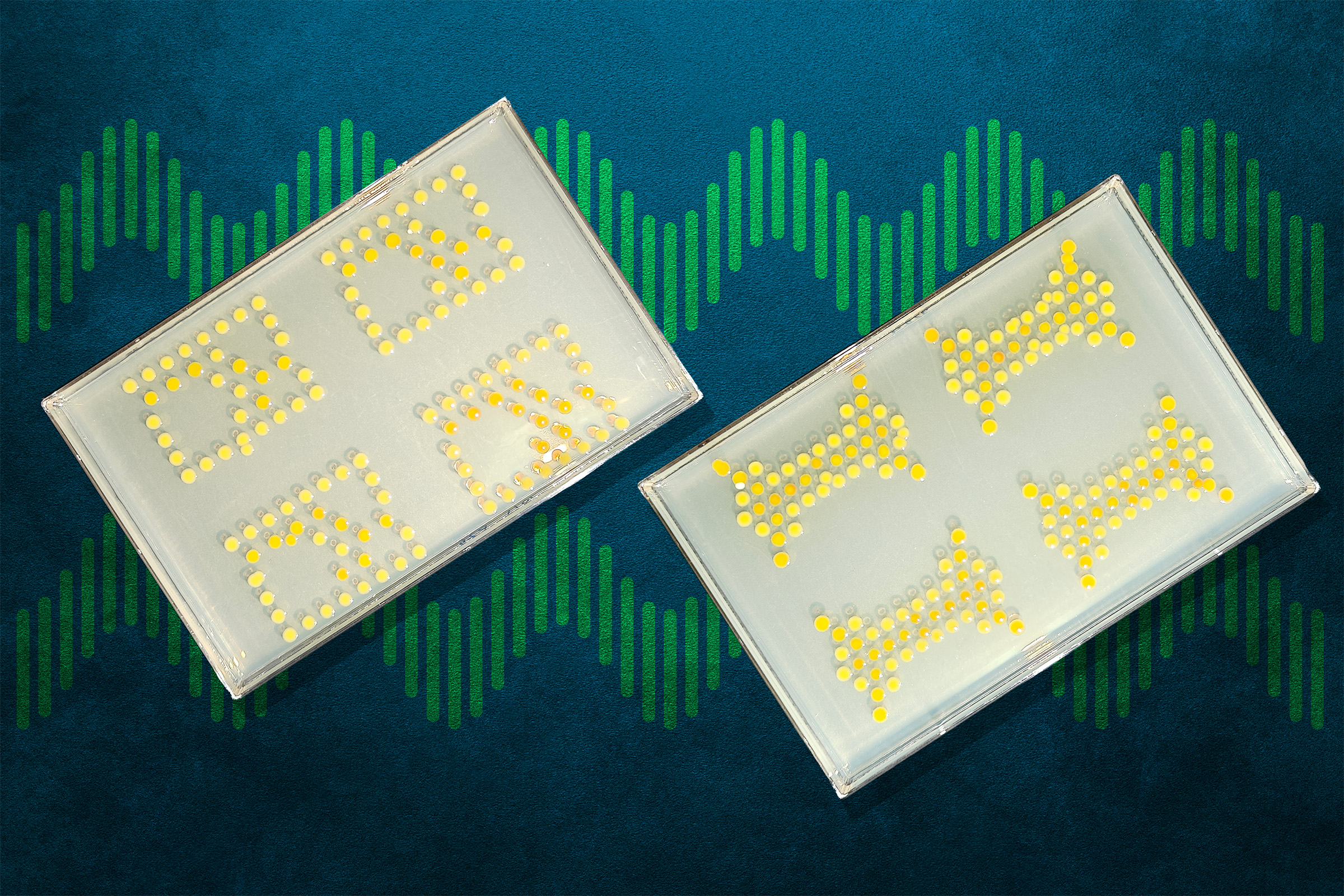
MIT engineers have engineered bacteria to function as transistors, enabling them to construct living "circuit boards" within a Petri dish. Transistors, in electrical circuits, serve as switches that can either allow or block current flow. In these biological circuits, bacterial switches govern the flow of small molecules, relaying signals to other components.
The research team developed two distinct transistors, alongside three separate bacterial strains that transmit information among the transistors, forming the foundation for constructing various circuit types. In a recent study, they utilized these bacteria to construct circuits capable of handling two or three inputs, or directing one input to a specific circuit location.
Lead author Hamid Doosthosseini explains, "We've developed some initial computer architecture components commonly utilized, but any operation can be achieved with these five strains." The ultimate objective is to devise circuits that can coat plant leaves or roots, enabling them to sense and react to environmental conditions such as drought or pest attacks.
Senior author Christopher Voigt, director of MIT's Department of Biological Engineering, and co-author Haorong Chen recently published their findings in Nature Chemical Biology. Traditional synthetic biology circuits involve engineering cells to express proteins and transcription factors that work together to accomplish tasks, like sensing molecules and triggering specific outputs.
However, this approach limits the complexity achievable within a single cell due to the restricted number of transcription factors available. To overcome this limitation, the researchers innovated by creating cells that function as transistors, which can be combined in diverse ways to form numerous circuits. Using the bacterium Pantoea agglomerans, the researchers crafted two transistor types activated by the molecule OC-6.
One transistor activates upon OC-6 input, while the other deactivates. Each transistor also detects target molecule OC-12. Upon its presence and based on the transistor's activation state, the transistor generates an output molecule called OHC-14. Additionally, three Pantoea agglomerans strains were employed to generate relays, translating the OHC-14 signal into a format suitable for feeding into another transistor.
By integrating these relay strains, the researchers effectively "wired" the transistors together, akin to an electronic circuit board. For instance, they developed a bidirectional switch using two OC-12-sensing transistors, which then relay information to distinct relay strains based on switch input, ultimately feeding into other transistors that further process the signal.
The researchers printed bacterial colonies onto agar plates, spacing them 5 millimeters apart to ensure signals traverse to the nearest colony, relaying them in a single direction. The study showcased transistors capable of executing multiple logic operations, including multi-input, OR, and imply gates, as well as more intricate circuits for adding signals, processing multiple signals concurrently, or acting as a demultiplexer.
The largest circuit, adding two inputs, comprised 24 bacterial colonies interconnected. Voigt notes, "Computationally, these circuits can match the capabilities of an iPhone." While the circuits require approximately eight hours to carry out calculations, this duration is deemed acceptable for biological applications. Voigt emphasizes, "We're not aiming to replace computers but incorporate computational control within biology.
If bacteria reside in a plant's root or the plant itself executes computations, overnight simple calculations are feasible relative to a plant's growth cycle." In agricultural contexts, these circuits could monitor plant stress levels, triggering responses like fungicide synthesis upon detecting specific inputs. Funded by the U.S. Defense Advanced Research Projects Agency and the U.S. Intelligence Advanced Research Projects Activity, this research holds promise for integrating computational control within biological systems.
Written by urgent.news from MIT News Research's reporting — not their text. Machine-written — may contain errors; check the original before relying on it.