Japan sets sights on the moons of Mars
JAPANESE scientists are readying a mission to Mars’ moons to retrieve samples that may unlock the origins of the Solar System and life on Earth, although a rival Chinese mission aims to make it back first.
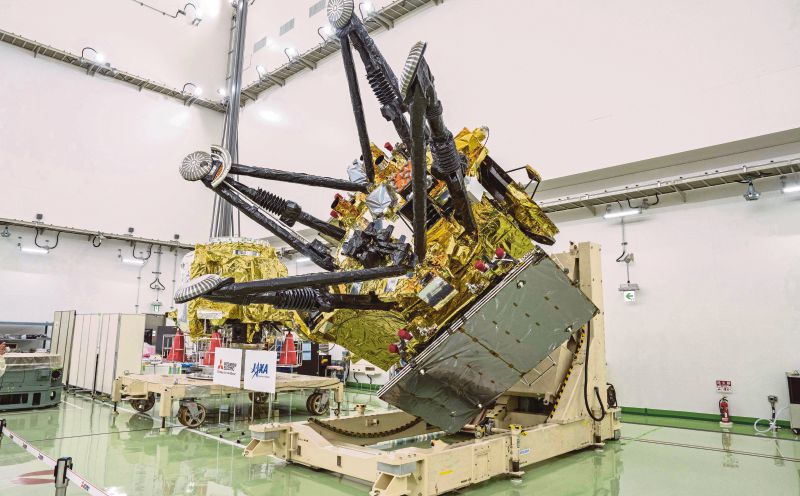
Japanese scientists are preparing an ambitious mission to explore the moons of Mars, with the goal of uncovering clues about the origins of our Solar System and life on Earth. The unmanned Martian Moons eXploration (MMX) spacecraft is set to launch from Tanegashima Space Centre in the coming months and will spend around three years orbiting Mars.
Its primary mission is to attempt a soft landing on Phobos, one of Mars' two moons, to collect at least 10 grams of material from its surface. A French rover named IDEFIX will accompany the spacecraft to conduct surface observations, while a separate mission will study Demos, the other Martian moon, without attempting a landing.
The spacecraft will then return to Earth, landing in Australia around 2031. The Japan Aerospace Exploration Agency (JAXA) hopes that this mission will provide valuable insights into the formation of Mars and its moons, which could shed light on the origins of the Solar System and the conditions necessary for life to emerge on rocky planets.
Patrick Michel, a French astrophysicist working on the IDEFIX rover, believes that the samples collected from Phobos and Deimos may hold the key to understanding how life arrived on Earth and could potentially be used as a "natural space station" to facilitate future human missions to Mars. The MMX mission is a collaborative effort involving France, Germany, the United States, and ESA, with contributions from various universities and technology companies.
While Japan has experience in sample return missions, such as the successful Hayabusa-2 mission that retrieved material from an asteroid in 2020, the MMX mission is currently facing stiff competition from other space agencies. NASA's Perseverance rover, which has been exploring Mars since 2021, has already collected samples for potential return to Earth, but its sample return mission has been delayed due to political reasons.
China's Tianwen-3 spacecraft, scheduled to launch around 2028, aims to return Mars samples to Earth by 2031, potentially earlier than Japan's MMX mission.
Written by urgent.news from New Straits Times's reporting — not their text. Machine-written — may contain errors; check the original before relying on it.