Colorful Collage of Tarantula Nebula
Data from NASA’s Chandra X-ray Observatory, NASA’s James Webb Space Telescope, and NASA’s Hubble Space Telescope combine to reveal a vibrant view of 30 Doradus, or the Tarantula Nebula, in this Aug. 11, 2026, image. Located in the Large Magellanic Cloud, a small neighbor galaxy to the Milky Way about 160,000 light-years from Earth, the […]
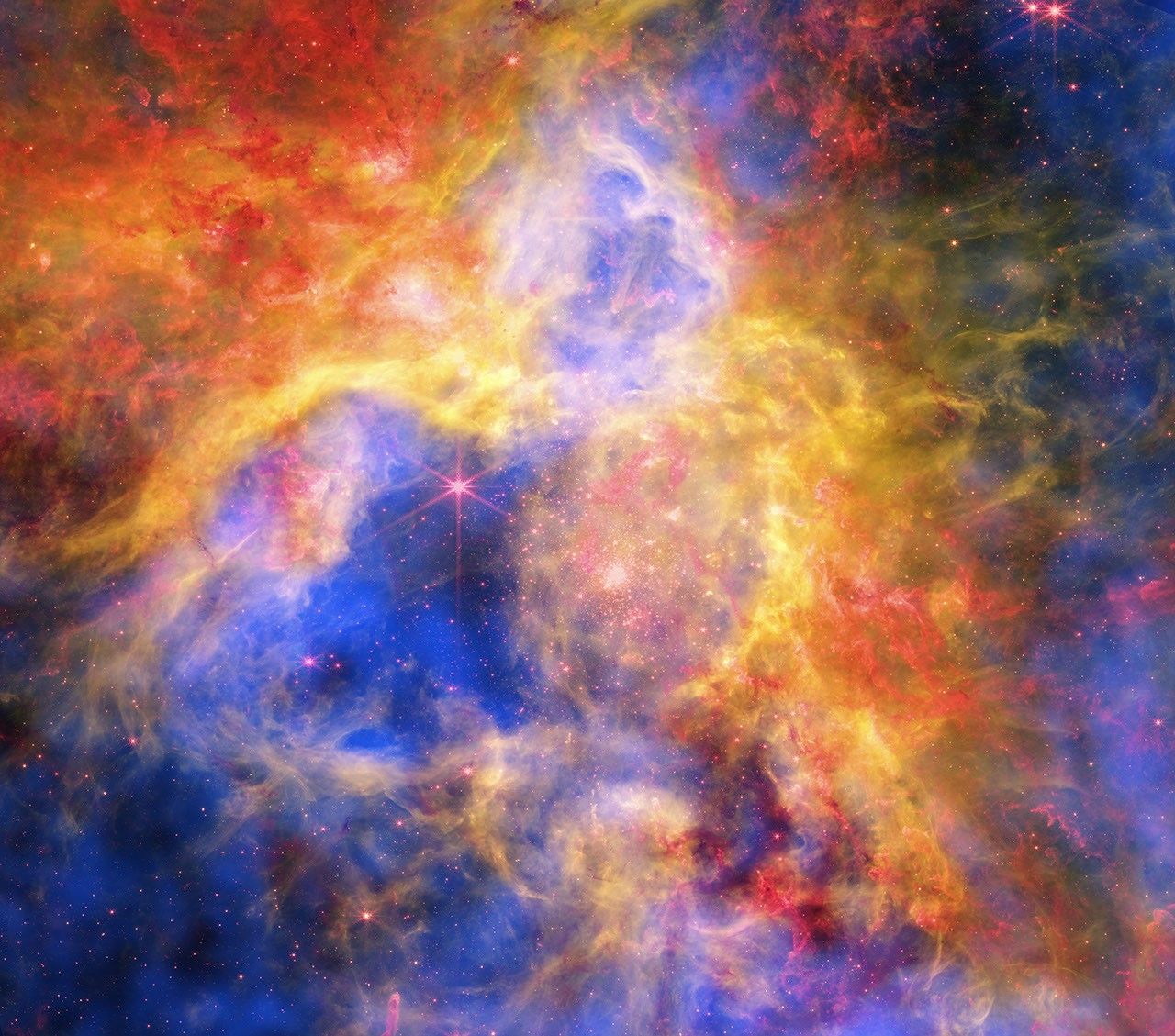
A stunning visual of the Tarantula Nebula, also known as 30 Doradus, was released by NASA on August 11, 2026. This striking image, created by merging data from three of NASA's space observatories - Chandra X-ray Observatory, James Webb Space Telescope, and Hubble Space Telescope - as well as data from the now-retired Spitzer Space Telescope, offers an unparalleled view of this celestial wonder.
The Tarantula Nebula is located within the Large Magellanic Cloud, a satellite galaxy of the Milky Way, situated approximately 160,000 light-years away from Earth. Embedded within a visually captivating honeycomb-like structure of gas and dust, there are thousands of young stars nestled within the nebula.
Through the analysis of the combined data, astronomers have deduced that the Tarantula may be experiencing energy loss through various means. One such source of energy depletion is the escape of hot gas from within the nebula's boundaries. This informative image is credited to the following sources: X-ray observations by the Chandra X-ray Observatory at NASA/CXC/Ohio State Univ., Infrared observations by NASA/ESA/CSA/STScI, Optical observations by NASA/ESA/STScI, and Image Processing by NASA/CXC/SAO/P. Edmonds.
Written by urgent.news from NASA's reporting — not their text. Machine-written — may contain errors; check the original before relying on it.
This story
This is one outlet's version. Read the fullest account.
- Colorful Collage of Tarantula Nebula nasa.gov