Analysis: The two largest reservoirs in the US have hit record-low levels
The second-largest reservoir in the US reached a record-low water height on Saturday – just days after the country’s largest… The post Analysis: The two largest reservoirs in the US have hit record-low levels appeared first on Carbon Brief .
The two largest reservoirs in the United States, Lake Mead and Lake Powell, have recently hit record-low water levels. These reservoirs are located on the Colorado River and serve as a vital water source for approximately 40 million people across seven Southwestern US states. They also support around 5.5 million acres of farmland. Climate change, population growth, and over-consumption are contributing to the current low levels of the reservoirs.
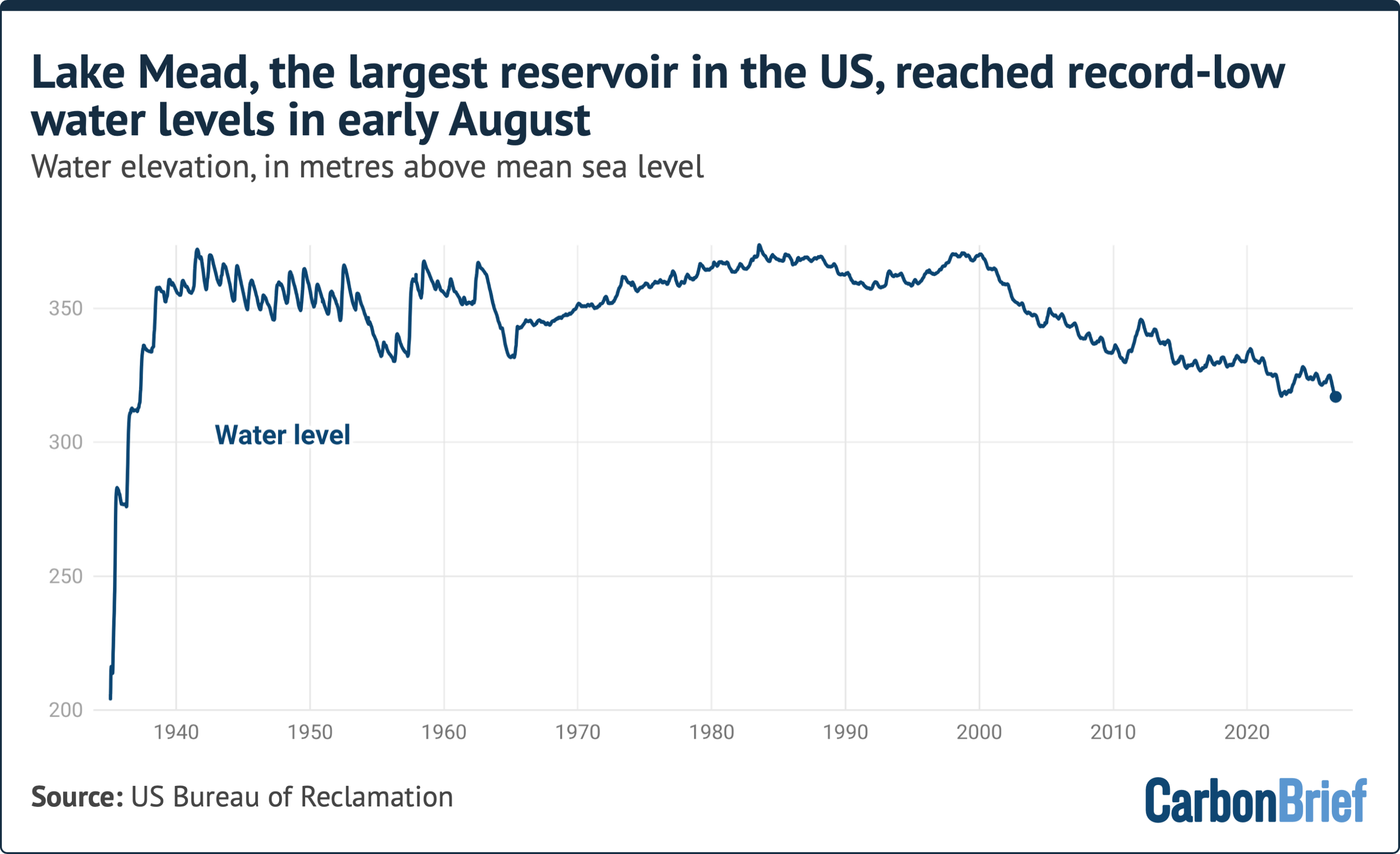
Lake Mead, which is fed by the Hoover Dam, reached its lowest water level of 317.11 meters above mean sea level on August 7th. With a full pool capacity of 347.60 meters, the reservoir has been declining for decades. Lake Powell, with a maximum capacity of 1,127.76 meters, hit a record low of 1,072.87 meters on August 15th. Since breaking its record, the water level in Lake Powell has continued to decline.
Experts warn that the downward trend will likely persist until spring when the snowpack in the Upper Colorado River Basin begins to melt. Dr. Jack Schmidt, a senior research scientist at Utah State University's Center for Colorado River Studies, states that "the big dilemma of the moment is that we're only in the middle of August, and we have no assurance of what the coming winter will be.
The only thing we can be sure of is that we will be depleting overall total basin reservoir storage from now until, roughly, early April." The current record lows are a result of several factors, with human-induced climate change being responsible for half of the decline in the river's flow since the turn of the 20th century. Most of the river's streamflow originates from the snowpack in the Upper Colorado River Basin, primarily in Colorado and Utah.
Written by urgent.news from Carbon Brief's reporting — not their text. Machine-written — may contain errors; check the original before relying on it.