Handynutzung: Warum diskutieren wir neue Social-Media-Wege nur für Kinder?
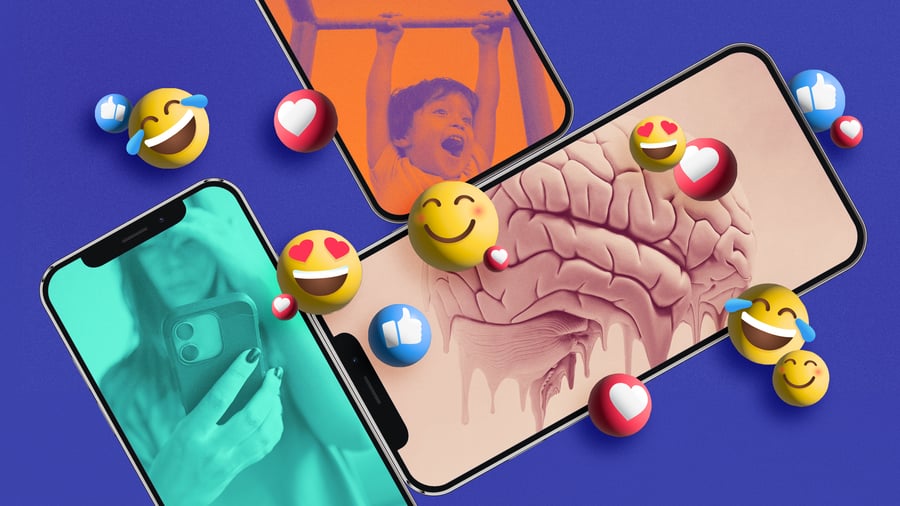
Die tägliche Reizflut zersetzt unsere Konzentration, befeuert die Vergesslichkeit und gewöhnt uns das Miteinander ab. Die Folgen für die Gesellschaft könnten verheerend sein. Was tun?
In an isolated room, the wooden beams vanish from the screen as one enters the old house on the Baltic Sea. Initially, the lack of reachability feels restrictive, but after 24 hours, it becomes liberating, despite the thumb persistently tapping on the smartphone display. It is a sufficiently slow place to serve as a starting point for a rapid journey, whose destination remains unclear.
"When we discuss social media and AI use, it is like discussing the largest experiment humanity has ever conducted," says Dr. Julia Brailovskaia, a professor at the German Center for Mental Health and the research and treatment center for mental health at Ruhr-University Bochum. She is one of the leading voices in Germany regarding the ban on social media, especially when it concerns children and teenagers.
Recently, a court in New Mexico ruled that US corporation Meta must deposit over half a billion dollars in a fund, as proven that it misuses the health of the young. Consequently, discussions worldwide about setting an age limit for social media usage have sparked controversy – or have they already been implemented? But is prohibition enough?
Should we not start from a different point instead? "Take a child's smartphone away, and you will understand how emotionally the device is for the child," says Malek Bajbouj, director of the psychiatry and psychotherapy clinic at Berlin's Charité. And what about an adult? Bajbouj says: "They react the same." The economy of attention, "the real problem is the information flood," adds Ralph Hertwig, director at the Max Planck Institute for Educational Research.
Hertwig is a decision researcher, one of the most prominent in the country. He is particularly concerned that, after losing concentration and focus in the age of artificial intelligence, we must also relearn to differentiate between right and wrong, good and bad. Decision-making is exhausting. Democracy and discourse are exhausting.
Hertwig states, "We must theoretically extend all considerations about regulation to adults because they fall under the same addictive mechanisms as youth, even if an individual tries to counteract them." The issue revolves around the so-called economy of attention, a term coined in the 1950s by Nobel laureate Herbert Simon with the famous phrase: "An abundance of information inevitably creates a shortage of attention."
This observation, originally, has become a reality. The worldwide available data amount grew from around two zettabytes in 2010 to 173.4 zettabytes in 2024. These numbers are so vast that few people comprehend their magnitude. A zettabyte is a one with 21 zeros. Generative AI is exponentially increasing the data amount, creating an information flood that no one can handle or process.
Above all, numerous platforms like Meta compete for one of our most limited resources: the ability to pay attention. Endless scrolling, push notifications, gamification, "all are highly developed, carefully designed mechanisms that capture our attention," says Hertwig. "We must actively reclaim our attention." For when we fail to do so, the sobering numbers illustrate the consequences.
Although the derivative costs directly attributed to excessive social media usage cannot be precisely quantified, researchers urge for more independent research on the subject. Even with the evidence in related disease categories, the scale becomes palpable. Alzheimer's disease, for example, is attributed to 45% by the Lancet Commission to modifiable lifestyle factors such as loneliness, sleep deprivation, and physical inactivity, costing German society around 83 billion euros in 2020.
By 2050, the Deutsche Zentrum für Neurodegenerative Erkrankungen expects the costs related to Alzheimer's to double, reaching up to 195 billion euros. Even a fraction of these risk factors exacerbated by digital overstimulation would be enough to significantly strain our already overburdened healthcare system. Mental illnesses already cause the longest work absences, with an average of 39 days per case.
Now, according to the German Health Ministry, mental illnesses already account for the longest work absences, averaging 39 days per case. Employees who are present but suffer from digital exhaustion and sleep deprivation are hardly productive. "Présentism" is the term economists use to describe this phenomenon. Axel Plünnecke from the Institute of the German Economy (IW) calculates that mental illnesses now account for nearly five percent of the gross domestic product.
Of this, only a small portion can be attributed to social media, he writes. However, it is also due to a lack of good data. Moreover, "loneliness, social fragmentation, and mental stress lead to decreasing political trust and reduced societal participation," Plünnecke notes. Social media, therefore, tendentially polarize and reinforce existing echo chambers.
According to Brailovskaia, there is clear evidence that "problematic excessive use of social media leads to"
Written by urgent.news from Handelsblatt's reporting — not their text. Machine-written — may contain errors; check the original before relying on it.
This story
This is one outlet's version. Read the fullest account.