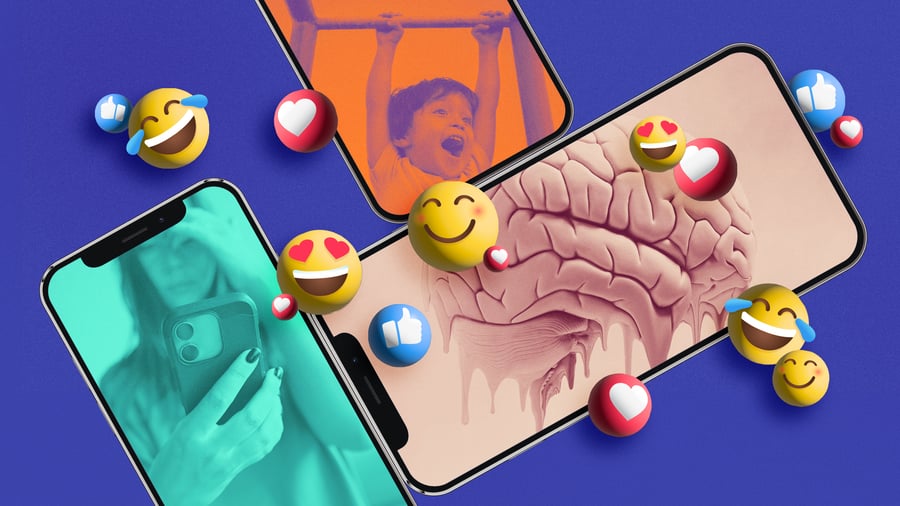
Mobile phone use: Why are we only discussing new social media pathways for children?
The daily flood of stimuli erodes our concentration, fuels forgetfulness and makes us unaccustomed to interacting with each other. The consequences for society could be devastating. What can we do?
This story begins in a dead zone. As soon as I enter the ancient thatched roof house on the Baltic coast, the bars on the screen disappear. The inaccessibility initially feels oppressive. But after no more than 24 hours, it feels liberating, even though my thumb still twitches like it's being controlled remotely to reach for my smartphone.
It's a slow enough place to use as a starting point for a thrilling journey whose destination is completely unclear. "When we talk about dealing with social media and AI, it's like we're discussing the biggest experiment ever conducted on humanity," says Julia Brailovskaia, professor at the German Center for Mental Health (DZPG) and the Research and Treatment Center for Mental Health at Ruhr University Bochum.
Brailovskaia is considered one of the leading German voices on social media bans, especially when it comes to children and adolescents. Just recently, a court in New Mexico ruled that US conglomerate Meta must pay more than half a billion dollars into a fund. It is considered proven that the company handles the health of the youngest in a way that is open to abuse.
From Germany to Malaysia, the world is discussing a age limit for social media use - or has already implemented it. From when, how, and why exactly should social media be banned? But does that even suffice? Shouldn't we start tackling the issue from a completely different angle? "Take a child's smartphone away, and you'll see how emotional the device is for the child," says Malek Bajbouj, director of the Clinic for Psychiatry and Psychotherapy at Berlin's Charité.
And what if you take an adult's smartphone away? Bajbouj says: "The adult reacts just the same." The economy of attention "The real problem is the flood of information. And that affects us all," adds Ralph Hertwig, director at the Max Planck Institute for Educational Research. Hertwig is a decision researcher, one of the most renowned in the country.
He is particularly concerned that after losing concentration and focus in the age of artificial intelligence, we are now also unlearning how to distinguish between yes and no, good and bad, right and wrong. Making decisions is strenuous. Democracy and discourse are strenuous. Hertwig says: "Of course, we must theoretically extend all considerations on regulation to adults as well.
They fall prey to the addictive mechanisms just like young people, even if they try to counteract as individuals." This is about the so-called economy of attention, a term that has been around since the 1950s. It was coined by Nobel laureate Herbert Simon and associated with a now legendary sentence: "An abundance of information necessarily produces a poverty of attention."
What was once primarily an observation is now a reality. The globally available data volume grew from around two zettabytes in 2010 to 173.4 zettabytes in 2024. These numbers have so many zeros that hardly anyone knows how many there are. One zettabyte is a one followed by 21 zeros. Due to generative AI, the amount of data is increasing exponentially.
And with it, a flood of information that no one can manage, let alone process. Above all, however, numerous platforms like Meta are competing for one of our now scarcest resources: the ability to pay attention. Endless scrolling, push notifications, gamification, "these are all highly developed, carefully thought-out mechanisms that take our attention hostage," says Hertwig.
"We must actively regain our attention." Because what happens if we don't do that, a few sobering numbers illustrate. Although the consequential costs that can be directly attributed to excessive social media use cannot be precisely quantified. Scientists are calling for more independent research on the topic, both locally and internationally.
For AI, the situation is even more tenuous. But the detour via related disease patterns makes the extent already tangible. Dementia, for example, which according to the Lancet Commission is 45 percent caused by modifiable lifestyle factors such as loneliness, lack of sleep, and lack of exercise, already cost German society around 83 billion euros in 2020.
By 2050, the German Center for Neurodegenerative Diseases expects the costs of dementia to more than double and rise to up to 195 billion euros. If only a fraction of these risk factors is reinforced by digital overstimulation - a connection is considered proven - that would be enough to severely destabilize our already overburdened healthcare system.
Mental illnesses, in turn, already cause the longest periods of absence from work, with an average of 39 days per case, according to the Federal Ministry of Health. Not every social media addiction automatically leads to inability to work, however. But even more expensive than actual days of absence are employees who, although present, are hardly productive due to digital exhaustion and lack of sleep.
Economists call this phenomenon "presenteeism." Axel Plünnecke from the Institute of German Economics (IW) calculates that mental illnesses now account for just under five percent of GDP. Only a very small part of this can be attributed to social media, he writes. But precisely because there is a lack of good data. In addition, "loneliness, social fragmentation, and mental stress lead to decreasing political trust and lower social participation," Plünnecke outlines.
Social media therefore tends to reinforce polarization and existing echo chambers. According to Brailovskaia, there is clear evidence that "problematic excessive use of social media...
Translated by urgent.news. Machine-written — may contain errors; check the original before relying on it.
This story
This is one outlet's version. Read the fullest account.