Nearly half of SA’s young people are not working or in training
NEET rate for 15-34 year olds has risen from 38% to 45% since 2012
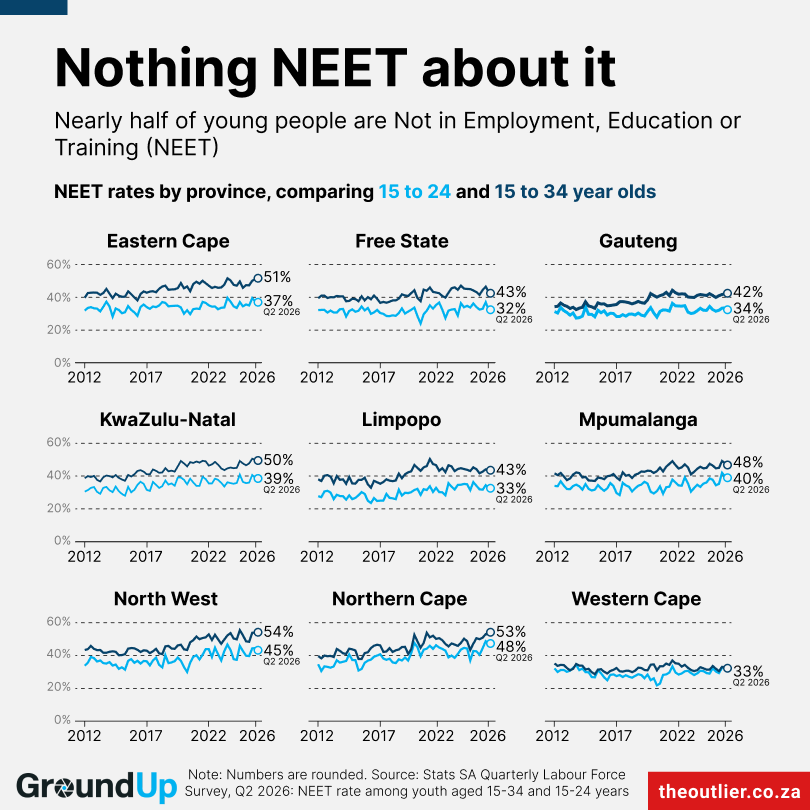
45% of South Africa's young people aged 15-34 are not in employment, education, or training (NEET), according to Stats SA. In 2012, the NEET rate was 38%. The NEET category encompasses those who did not work during the survey's reference week and are not enrolled in education or training, as well as individuals inactive for other reasons, such as caring for family or being ill or disabled.
However, anyone who earned even an hour of paid work or is currently enrolled in education or training, regardless of whether they work or not, is excluded from the NEET classification. The latest NEET figures were published on Tuesday. In most provinces, there is a disparity between the NEET rates for 15-24 year-olds and 15-34 year-olds, as individuals in the younger age range are more likely to be in school or tertiary education.
They often transition to the NEET category upon completing their education due to a lack of job opportunities. The Western Cape stands out as an exception, with a minimal gap between NEET rates for the two age groups, likely due to a lower overall unemployment rate and a higher likelihood of young people transitioning from education to employment in this province.
The NEET rate has also remained more stable in the Western Cape compared to other provinces. Conversely, the Northern Cape has the highest NEET rate, with 48% of 15-24 year-olds and 53% of 15-34 year-olds falling into this category. There has been some debate regarding the accuracy of Stats SA's unemployment measurement. Former Capitec CEO Gerrie Fourie argued, based on Capitec's transactional data, that people working in the informal economy are undercounted, suggesting a real unemployment rate closer to 10% rather than the official rate of 32.9%.
Entrepreneur GG Alcock contends that including both owners and employees of informal businesses in the employment count could lower the unemployment rate to around 12 or 15%. However, Stats SA refuted Fourie's claim, emphasizing that their methodology does account for the informal economy and acknowledging the potential for improvement.
Fourie also posited that some recipients of social grants, like the R370 SRD grant, might not truthfully report their employment status during labor force surveys, as earnings exceeding R624 a month would disqualify them from receiving the grant. The one-hour work threshold in the surveys is considered too lenient. Active participants in the informal economy should be excluded from the NEET classification.
Written by urgent.news from GroundUp's reporting — not their text. Machine-written — may contain errors; check the original before relying on it.