A look back at the 2026 total solar eclipse
On 12 August 2026, Europe witnessed the first total solar eclipse in over two decades. Millions of people were awed by the Moon completely covering the Sun's bright disc, briefly turning day into night and revealing the Sun's outer atmosphere. Totality could be seen from Greenland, Iceland, Spain and Portugal, while most of the rest of Europe saw a partial eclipse.
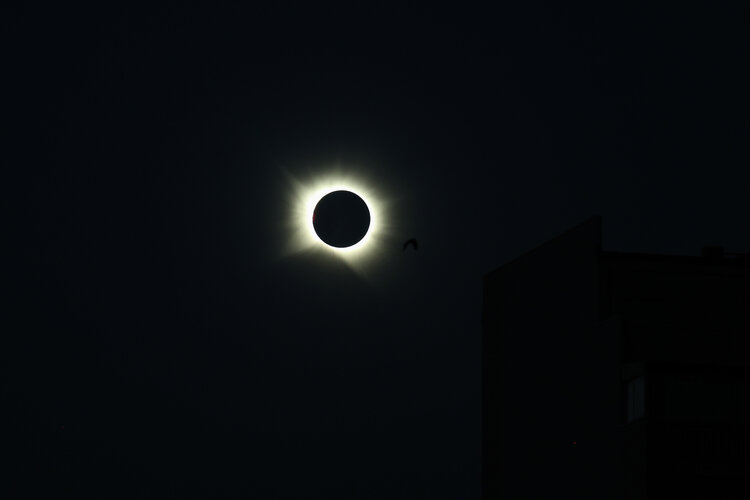
On August 12, 2026, Europe experienced its first total solar eclipse in over two decades. Millions marveled as the Moon completely obscured the Sun's bright surface, casting the sky into a temporary night. Totality was visible from Greenland, Iceland, Spain, and Portugal, while the remainder of Europe witnessed a partial eclipse.
As the lunar disk eclipsed more of the Sun, daylight faded and temperatures dropped. Shadows became sharper, and shadows cast by leaves or even colanders against the light formed crescent shapes on the ground. Right before the Sun's entire disc was blocked, small beads of light appeared along the Moon's edge, where sunlight filtered through lunar valleys.
In a final brilliant flash, known as the diamond ring effect, totality commenced, revealing the Sun's outer atmosphere. Professor Carole Mundell of the European Space Agency described the experience as "boggles the mind," emphasizing the incredible detail and unique nighttime light. ESA provided live telescope feeds from Spain's Observatorio Astrofísico de Javalambre, Palencia, and Javalambre, alongside photos from photographers across Europe.
Satellite MTG-I1 tracked the Moon's shadow across Earth, while Proba-3 captured a double eclipse from orbit. Proba-2 experienced the Moon's shadow several times. For those unable to view totality, ESA offered a live broadcast featuring scientists and researchers, including Dame Dr Maggie Aderin, who discussed the Sun, its corona, and ESA's artificial eclipses.
Over ten to twelve thousand people attended a free public event at the Palacio de Exposiciones y Congresos de León, featuring hands-on workshops, demonstrations, and interactive activities. The event highlighted the 'inclusive eclipse' workshop, where ESA's CESAR science education team showcased tools to experience an eclipse without using eyes, such as tactile models of the Sun, Moon, and Earth, and Micro:bit and LightSound sensors that convert light changes into sound.
Another popular activity involved creating pinhole cameras for safely observing the eclipse. The next total solar eclipse visible in Europe will be on August 2, 2027, and an annular eclipse on January 26, 2028.
Written by urgent.news from ESA Space Science's reporting — not their text. Machine-written — may contain errors; check the original before relying on it.