Vor der Wahl in Sachsen-Anhalt: Ein Kaffee mit Herrn Siegmund? So lief die MDR-Wahlarena
In knapp vier Wochen wählt Sachsen-Anhalt einen neuen Landtag, die AfD liegt weit vorn. Was treibt die Bürgerinnen und Bürger um? Eine Fernsehdebatte macht deutlich, wo der Schuh drückt.
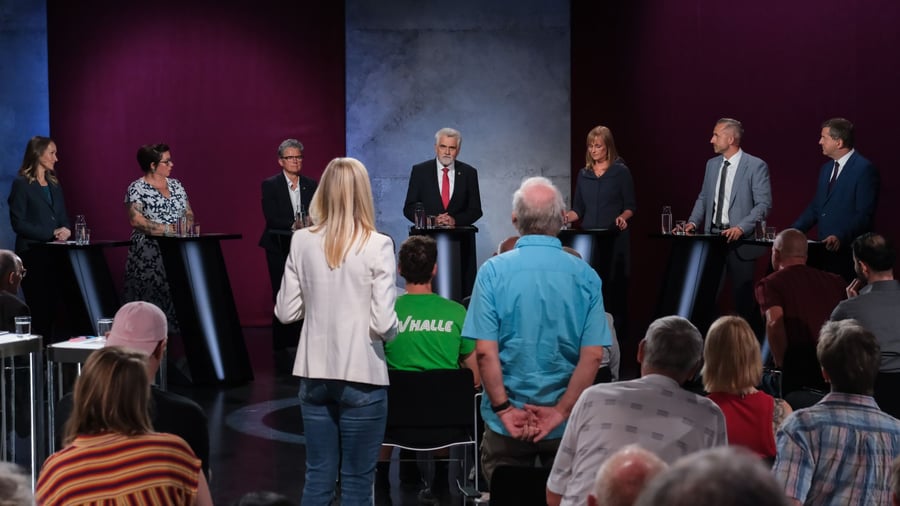
Almost four weeks before the state election in Saxony-Anhalt, the leading candidates of the parties took part in a televised debate to address a wide range of citizen concerns - from education to gas supply, migration to war and peace. The MDR live program "Fakt ist! Wahlarena" with 50 interested viewers centered on worries about the state of democracy, societal division, and the future role of the AfD, which in polls leads with more than 40 percent.
The 'Wall' The other parties' handling of the AfD was a major topic for the studio audience. A viewer named Silvio counted the AfD as part of the civic center and asked CDU Minister-President Sven Schulze about the purpose of the 'Wall'. The head of government denied using the term 'Wall'. Schulze said he wanted to engage with the AfD voters, but Schulze.
A man in a blue shirt was angry that over 40 percent of voters would be excluded and said CDU and SPD were no longer electable for him. SPD Spokesperson Armin Willingmann countered: "The handling of the AfD is a matter of stance." Left leader Eva von Angern warned against falling for the 'victim myth' of the AfD and experiencing much anxiety at election campaign stands.
AfD Spokesperson Ulrich Siegmund claimed he experienced "a lot of upward momentum" and positive reactions. Already after the first 15 minutes, the debate was over. The Education The voters are clearly concerned with education and the handling of disabled children in schools. A teacher from Wernigerode asked Siegmund how the AfD's desired abolition of compulsory schooling and replacement with an education duty would ensure equal opportunities.
Siegmund said homeschooling could help children who experience extreme bullying at school. Overall, it's only about 30 families in Saxony-Anhalt for whom this applies. Compulsory schooling in Germany is internationally unique. FDP candidate Lydia Hüskens defended the retention of compulsory schooling, which all other parties support.
Even the universities and possible contracts with the arms industry were on the agenda. BSW candidate Claudia Wittig warned of the dangers of supporting Ukraine in the war against Russia. "We are actively inviting a war into our homes by using civilian infrastructure for military purposes," she said. She also spoke of underfunding of universities.
This prompted SPD candidate Willingmann to call it "plain nonsense." University funding in Saxony-Anhalt was solid, Willingmann argued. The polarization How can society overcome polarization? A woman in the studio audience asked this question. Siegmund was conciliatory, saying "Let's talk to each other in peace." Left leader von Angern accused him of not wanting to have a coffee with her.
Siegmund confirmed this and praised von Angern, with the AfD man saying "The door is open and the hand is outstretched." Siegmund even extended the offer of coffee to a man who had migrated from Syria. He expressed concern that the AfD might abolish democracy in Saxony-Anhalt. Remigration, political purges, that would be "the best recipe for dictatorship", said the young man, and he affirmed that he would rather see the opposite.
Siegmund, who received the most questions and speaking time, dismissed the AfD's program as too soft and disparaging of the country. The Green candidate Susan Sziborra-Seidlitz praised her state, saying it is full of wonderful people and active civil society. The voters worry about an AfD government, she said. The election The latest Pollytix poll for the organization Campact shows the AfD with 43 percent of the vote, the CDU with 23 percent, the Left with 13 percent, the SPD with 7 percent, and the Greens with 5 percent.
The AfD would not enter the state parliament based on these polls, with the other parties trailing behind. The debates continue in several media rounds before the election on September 6th.
Written by urgent.news from Handelsblatt's reporting — not their text. Machine-written — may contain errors; check the original before relying on it.