The work that won Deepak Dhar the Dirac Medal | Explained
The Dirac Medal is awarded to physicists who have made outstanding contributions to theoretical physics but who have not already received the very top honours, especially the Nobel Prizes
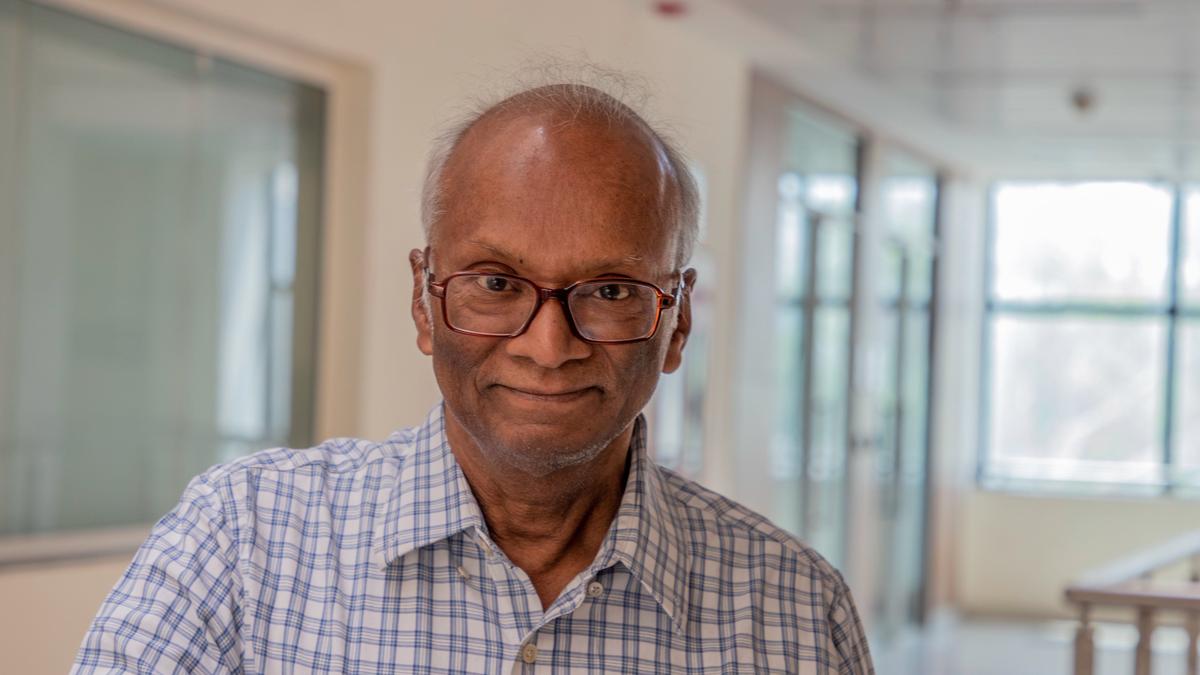
Theoretical physicist Deepak Dhar has been awarded the prestigious Dirac Medal by the International Centre for Theoretical Physics (ICTP) in Trieste, Italy. The ICTP honors him, along with Bernard Derrida, Marc Mézard, and Haim Sompolinsky, for their significant contributions to theoretical physics. Established in 1985 to celebrate the late British physicist Paul A.M. Dirac, the Dirac Medal is presented to outstanding physicists who have not yet received the Nobel Prize, Fields Medal, or Wolf Prize.
Dhar, who has spent most of his career in India, is a renowned expert in statistical physics. He is particularly recognized for his work on the Abelian sandpile model, a mathematical representation of his concept of Abelian self-organized criticality. This model simplifies complex natural phenomena, such as earthquakes, forest fires, and neural network activity, by capturing their general characteristic of building up instability and releasing it unpredictably.
Born in 1951 in Pratapgarh, Uttar Pradesh, Dhar pursued his education at Allahabad University, IIT-Kanpur, and the California Institute of Technology (Caltech), where he also served as a teaching assistant to Richard Feynman. After completing his PhD in 1978, he returned to India and held positions at the Tata Institute of Fundamental Research in Mumbai and the Indian Institute of Science Education and Research in Pune.
Since 2024, he has served as the INSA Distinguished Professor at the International Centre for Theoretical Sciences in Bengaluru.
In addition to the Dirac Medal, Dhar has received numerous accolades for his research, including the Shanti Swarup Bhatnagar Prize in 1991, the TWAS Prize in 2002, the Padma Bhushan in 2023, and the Boltzmann Medal in 2022, alongside John Hopfield. The Dirac Medal, therefore, recognizes Dhar for his groundbreaking work in applying statistical mechanics to understand a wide range of complex systems, while also celebrating the ICTP's mission to foster global scientific collaboration.
Written by urgent.news from The Hindu's reporting — not their text. Machine-written — may contain errors; check the original before relying on it.