Skies darken as solar eclipse heads south from Arctic to Spain
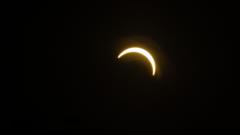
One of nature's greatest spectacles—a rare total solar eclipse—cast its shadow on Wednesday, briefly turning day into night in Russia's remote Arctic north and western Iceland before heading toward mainland Europe.

On Wednesday, a rare total solar eclipse cast its shadow across the Arctic, Russia, and western Iceland before heading towards mainland Europe. The celestial event began at approximately 5 p.m. GMT near the northern tip of Russia, where the moon obscured the sun, leaving only the shimmering corona visible. The eclipse raced south through Greenland before total darkness fell over Keflavik, Iceland, at 5:47 p.m. GMT.
The town of Reykjavik, which had last witnessed a total solar eclipse in 1433, was set to experience one again after a 20-year wait. The narrow path of totality then arced diagonally across western Spain and into the Mediterranean Sea, a region that has never experienced a total solar eclipse in over a century. Local residents, such as Yenny Guevera, a 50-year-old Peruvian living in France, expressed excitement about the rare spectacle, as did engineer Mercedes Bua, a 51-year-old engineer.
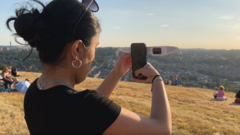
The public's enthusiasm was evident, with large crowds gathering to watch the partial eclipse and even South Korean tourists in Lodoso, near Burgos, Spain. The event, which was visible in Canada, the northern United States, and northwest Africa, lasted around 1 hour and 45 minutes. Solar physicist Lucie Green described it as "a moving experience," and British astrophysicist Graham Jones highlighted the unique opportunity for scientists to study the sun's atmosphere and magnetic field during the event.
Spain's government predicted nearly 450,000 extra tourists would bring a 347 million euro ($400 million) boost to the economy, with 25,000 police officers mobilized to ensure the safe passage of the event.
Written by urgent.news from Phys.org's reporting — not their text. Machine-written — may contain errors; check the original before relying on it.