Astronomers Find Black Hole Star in Early Universe
Roughly 660 million years after the Big Bang, a strange bright red spot has been hiding in plain sight in one of the deepest fields ever imaged by the NASA/ESA/CSA James Webb Space Telescope. The post Astronomers Find Black Hole Star in Early Universe appeared first on Sci.News: Breaking Science News .
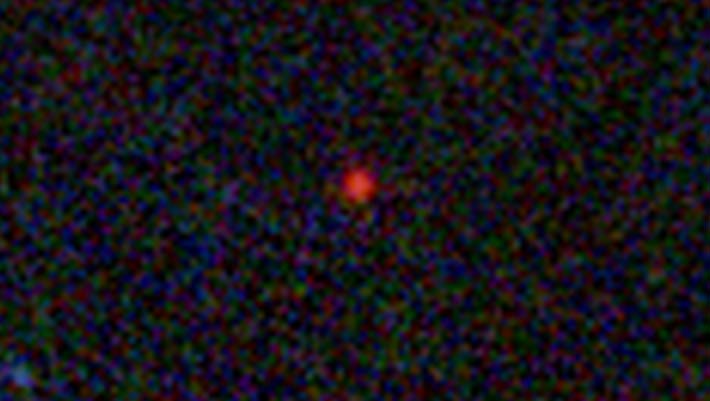
Astronomers have identified a novel celestial entity: a black hole "star" that spans the size of the entire solar system and emits a brilliant red glow from billions of light years away. This discovery was made by an international team utilizing data from NASA's James Webb space telescope, focusing on a mysterious red spot in early universe images. The object, located in the constellation Cetus, formed around 660 million years after the Big Bang.
The team measured the object and found it resembles a massive star yet releases 100 billion times more energy than any known star, closer to black hole energy output. Dr. Rohan Naidu, who led the research at MIT's Kavli Institute for Astrophysics and Space Research, described it as possessing "signatures classically associated with stars" while exhibiting the energy characteristic of black holes.
The scientists were initially searching for the most distant galaxies using the James Webb telescope. After identifying a galaxy that formed 280 million years after the Big Bang, they turned their attention to the extremely bright red spot MoM-BH*-1, the reddest object in their archive. Its nearly entirely red light abruptly disappearing below a certain wavelength set it apart from any known celestial object.
This discovery suggests that many other mysterious red dots, known as Little Red Dots (LRDs), observed in deep space images from the James Webb telescope could also be black hole stars. Naidu hypothesizes that black hole stars could play a significant role in the evolution of galaxies, potentially serving as the 'seed' for present-day supermassive black holes and influencing the formation of stars, planets, and even life itself.
Written by urgent.news from Guardian Science's reporting — not their text. Machine-written — may contain errors; check the original before relying on it.
This story
This is one outlet's version. Read the fullest account.