Small entrepreneurs: Is Afghanistan's future in the work of women?
Five years ago, the Taliban took back Afghanistan. Since then, they have been suppressing women's rights. But their businesses are a bright spot in an otherwise bleak economic situation.
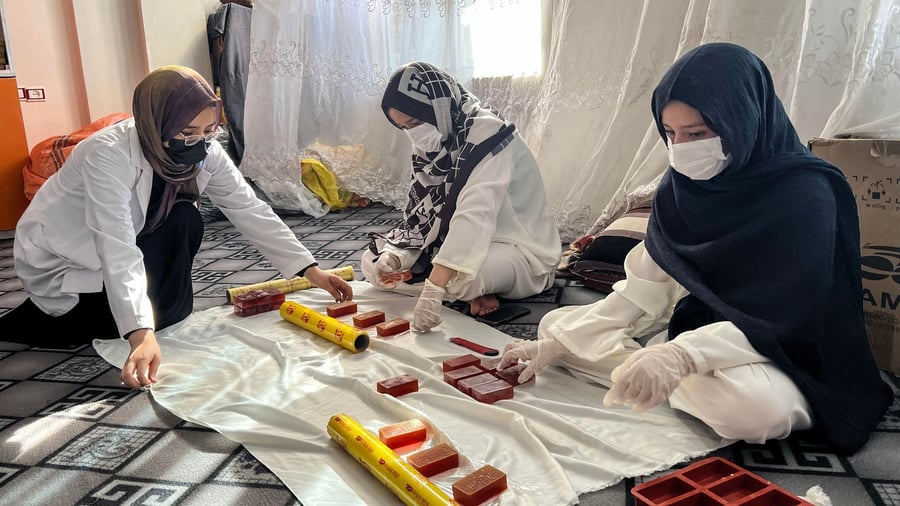
Slowly, Rukia Resai peels reddish soap bars out of a silicone mold and stacks them on top of each other. It smells like fresh herbs, saffron, and turmeric - the small soap factory in western Afghanistan is running at full speed. For five years, the Islamist Taliban have ruled the Central Asian country again. In August 2021, they took control of the country and then the capital Kabul in a lightning-fast offensive.
Since then, Afghanistan has plunged into an ever-deeper humanitarian crisis. But women are a glimmer of hope. Four years ago, 21-year-old Rukia Resai founded the small factory in the western Afghan city of Herat. She was not allowed to study under the Taliban, had to finish school in a hurry, and her father had lost his business.
Now, eight employees work regularly for Resai's family business, and many more during peak order times. Through her work, not only she herself but also her sisters, whom she was able to involve, have found a way out of a difficult time. "Overall, the mental health of our entire family has improved through this work," Resai says.
Millions of children malnourished However, the humanitarian situation in Afghanistan has worsened since the Taliban took over five years ago. With the collapse of the previous government, the economy initially collapsed, followed by exclusion from the international financial system, and aid money is increasingly lacking. Almost 40 percent of the population could be acutely affected by food insecurity during the winter months, and at least 3.7 million young children in Afghanistan are considered acutely malnourished.
Representatives of international aid organizations usually only talk about a drop in the ocean when discussing their programs. But it's not just money that's lacking. Approximately 3.9 million people have returned from neighboring countries Iran and Pakistan alone in the past five years, either voluntarily or under pressure, according to the UN Refugee Agency (UNHCR).
The World Bank writes that the Afghan economy did grow last year. However, with massive immigration, Afghans have become much poorer per capita. In addition, a conflict with neighboring Pakistan is burdening the country: Islamabad has closed border crossings for goods traffic due to mutual attacks, so melons and nuts from Afghanistan can no longer cross the border, and imports via Pakistani ports have also become impossible.
Taliban restrict women's freedom of movement And above all, there are the restrictions that the Taliban impose in everyday life - particularly on women. Women are not allowed to work in offices, must be accompanied by men on their way, and must be fully veiled. There is also inconsistent enforcement of regulations in the provinces and arbitrariness.
Ghoncheh Karimi knows this very well. The 39-year-old beekeeper disguises herself as a man every day since the Taliban took power, to ride 15 kilometers on her motorcycle to her beehives in the Herat area. Once, she was arrested by the Taliban because of her disguise. During an interrogation, she was asked if she was not afraid of the new government.
"Instead of selling my body, I decided to wear men's clothes, ride my motorcycle, go to work, earn honest money, and bring food to my family's table," Karimi replied. She was then released. She started beekeeping 18 years ago. She now maintains 120 beehives and trains men and women in the craft. She can cover all family expenses with her income and recently paid for her son's eye surgery.
"Today, I am proud to say that I can contribute to my children's dreams coming true by selling honey," says the beekeeper. Latif Nasari, Deputy Afghan Minister of Economy, tells the German Press Agency that his ministry supports women's businesses within Islamic norms. Women work in small and medium-sized enterprises and, "if necessary," at airports, banks, or security industries.
Afghanistan wants to achieve sustainable economic growth, and women contribute to this while respecting national values, he says. However, experts report that women are hardly granted work permits for employment, in reality. World Bank: Women-led businesses more successful The private sector currently carries the fragile economic growth in Afghanistan, writes the World Bank in an analysis.
Women-led businesses perform much better than those led by men: Not only does their sales growth stronger, but they also hire more employees much faster. The economy in Afghanistan could be doing much better if women were not subject to so many restrictions, it is said. But it's not just the rules. Money is also lacking. Rukia Resai would like to expand her soap business.
Marketing works well through social media, but last year, she received an order to export to Tajikistan on a large scale for the first time. But she couldn't expand her production capacity quickly enough. This is because they still work in a 12-square-meter kitchen. Resai reports that restrictions have worsened since this year. Nevertheless: "People should not wait for someone to come and save them. They won't come. People can only save themselves."
Translated by urgent.news. Machine-written — may contain errors; check the original before relying on it.