How to Watch the Total Solar Eclipse on a Live Stream, Witnessing the Rare View of the Sun's Corona From Your Own Home
Wednesday’s eclipse will bring dark skies to parts of Russia, Greenland, Iceland, Portugal and Spain. But with these online broadcasts, you can view the spectacle from anywhere
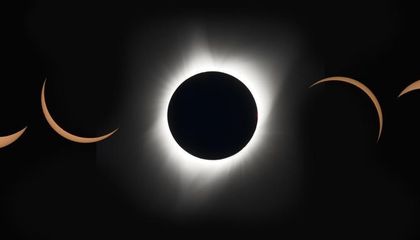
The stage is set for an extraordinary celestial event on August 12: a total solar eclipse that will not return to Earth for another 28 months. In this narrow band of darkness, sky-watchers will be treated to a rare glimpse of the sun's outer atmosphere, the corona. The narrow path of totality will traverse a variety of landscapes, including parts of Russia, Greenland, Iceland, Portugal, and Spain. This means that for the first time in nearly 25 years, mainland Europe will witness a total eclipse since 1999.
Even in northern Greenland, where the midnight sun reigns, the total solar eclipse will plunge the region into darkness for just two minutes and 18 seconds. Despite its short duration, this fleeting event promises a spectacular view of stars shining amidst a sky that usually never darkens.
While the eclipse's visibility will be limited to about 15 million residents along the path of totality, space agencies, museums, and other organizations will provide live streaming options for those unable to witness it firsthand. The European Space Agency (ESA) will broadcast from the Astrophysical Observatory of Javalambre in Teruel, Spain, beginning at 1:30 p.m. Eastern time.
Special guests, including Space scientist Maggie Aderin and ESA Director of Science Carole Mundell, will be joined by experts to discuss space weather and solar eclipse science.
To complement the ESA's coverage, NASA will provide a live feed of the eclipse at 1:15 p.m. Eastern time. Additionally, NASA-funded balloon and aircraft projects will collect scientific data during the event, with balloons launched in Iceland and Spain and a high-altitude jet chasing totality to capture detailed images of the corona.
Elsewhere, the Exploratorium in San Francisco will stream live from Villalibado, Spain, along with the Virtual Telescope Project, offering views from Italy. For those in the U.K. and Ireland, the partial solar eclipse will cover 90-96 percent of the sun, providing a unique view for residents of Cornwall, Devon, and other areas. The Royal Observatory Greenwich will offer a livestream from their telescopes at 1:10 p.m. Eastern time.
Through these various streams and broadcasts, sky-watchers across the globe will have the opportunity to witness the mesmerizing spectacle of the total solar eclipse, even if they are not in the direct path of the moon's shadow.
Written by urgent.news from Smithsonian's reporting — not their text. Machine-written — may contain errors; check the original before relying on it.
This story
This is one outlet's version. Read the fullest account.
- Solar eclipse sparks scramble for protective glasses across Europe punchng.com
- Solar eclipse sparks scramble for protective glasses across Europe phys.org
- Solar eclipse sparks scramble for protective glasses across Europe thelocal.se
- Solar eclipse sparks scramble for protective glasses across Europe thelocal.fr
- Solar eclipse sparks scramble for protective glasses across Europe thelocal.es
- Solar eclipse sparks scramble for protective glasses across Europe thelocal.de
- Solar eclipse sparks scramble for protective glasses across Europe torontosun.com
- Solar eclipse glasses 'sold out everywhere' as people look for alternatives bbc.co.uk