Explosive 'Mountain of God' spits out the fastest-flowing lava on Earth — Earth from space
A 2020 astronaut photo shows the unique structure of Ol Doinyo Lengai, an active stratovolcano in Tanzania that was recently adorned with a bright white "ash cone." The explosive peak produces a rare type of lava that is unusually cool but travels remarkably quickly.
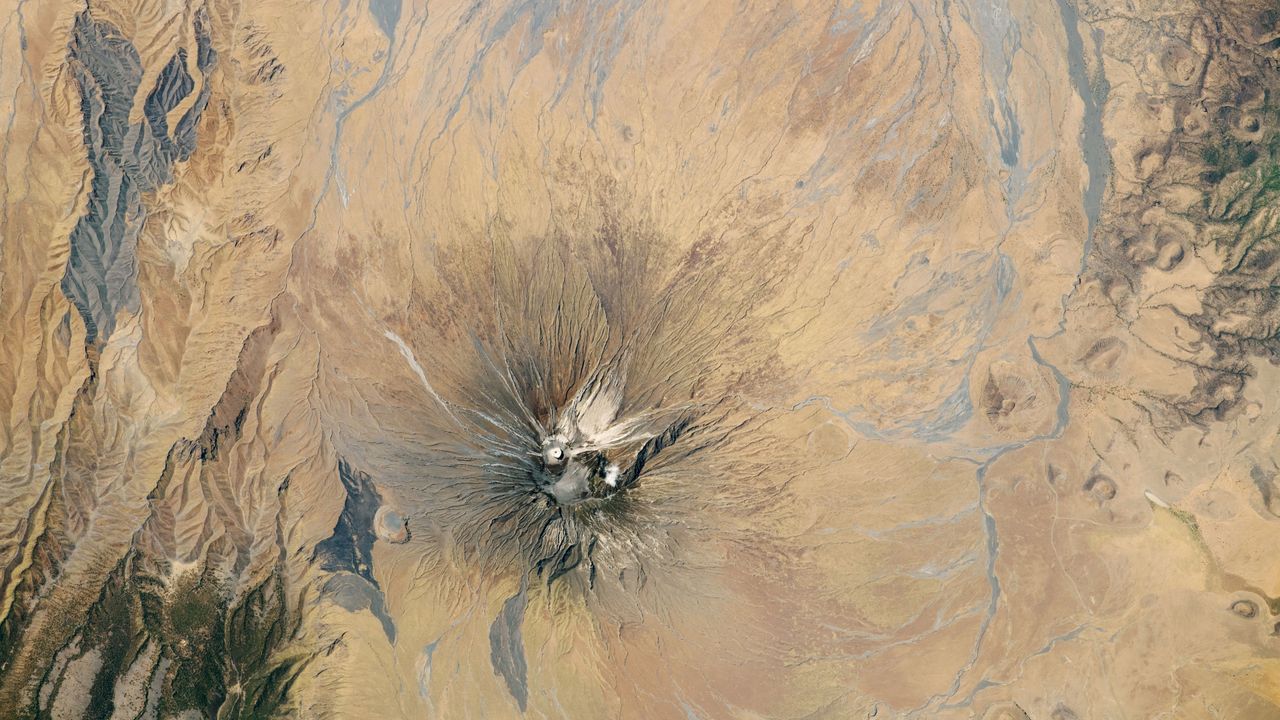
A recent astronaut photograph from the International Space Station captures Ol Doinyo Lengai, a volcano in Tanzania known for its unique lava flows. The highly active mountain, also called the "Mountain of God" by the Maasai people, stands 9,718 feet (2,692 meters) tall in the Arusha region.
Ol Doinyo Lengai's lava is particularly noteworthy for its cool temperature, reaching as low as 600 degrees Celsius, and its pale appearance upon cooling. This is a result of its low silica content, creating natrocarbonatite rock. The volcano's eruptions alternate between effusive, with lava slowly oozing out, and explosive, dramatically reshaping its appearance.
The most recent effusive eruption began in April 2017, continuously spewing out rivers of lava that solidify into pale flows. These lava streams are some of the fastest-moving on Earth, according to NASA's Earth Observatory. The youngest of these flows, from 1998, can be seen in the astronaut photo as a crown atop the summit's ash cone.
Situated at the East African Rift System, Ol Doinyo Lengai has a long geological history, spanning over 25 million years. The region's tectonic activity has formed iconic landmarks like Mount Kilimanjaro and Mount Kenya. Near the volcano lies Lake Natron, a red salt lake teeming with flamingos, adding a vivid contrast to this extraordinary landscape.
Written by urgent.news from Live Science's reporting — not their text. Machine-written — may contain errors; check the original before relying on it.