Beyond the numbers: why China’s carrier force won’t copy the US model
Having marked its 99th anniversary on August 1, the People’s Liberation Army is now just a year away from its centenary goals, with its evolution highlighting the past, present and future of China’s military strategy. In the sixth part of a series, Gabriel Dominguez looks at Beijing’s evolving aircraft carrier doctrine. Debate over China’s aircraft carrier ambitions has long centred on how many…
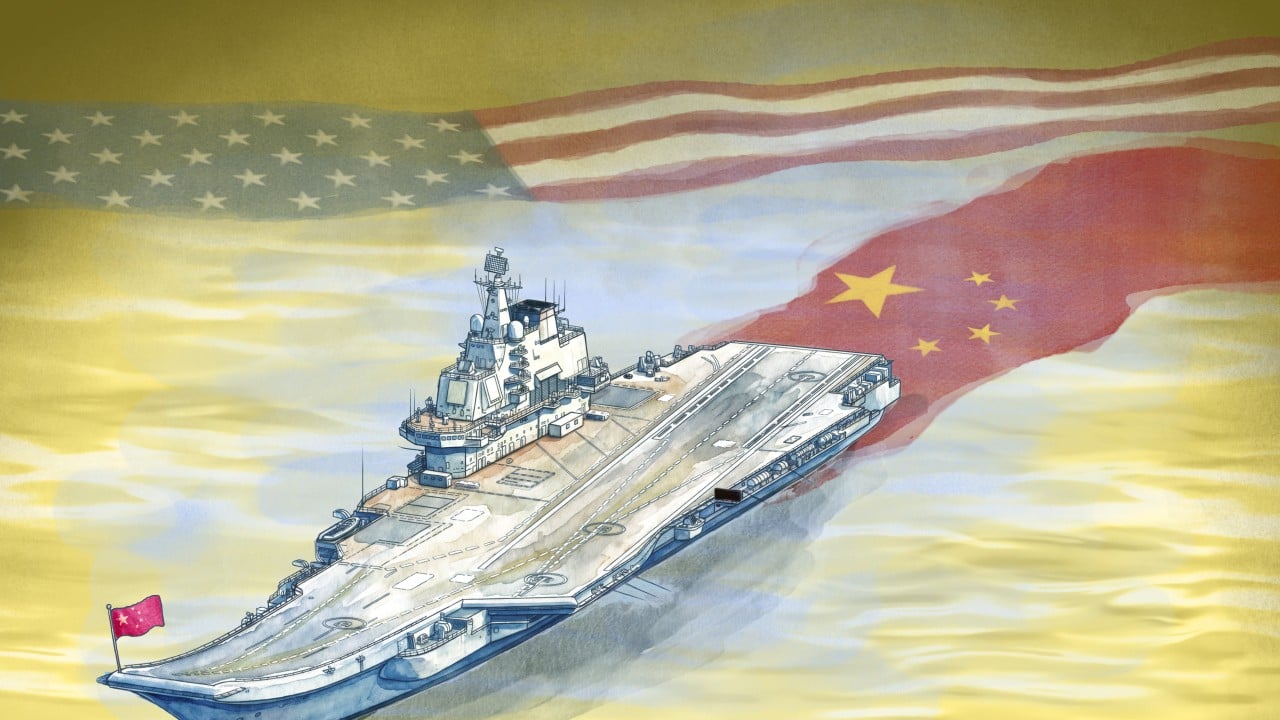
China's aircraft carrier force is set to mark its 99th anniversary on August 1, with the nation edging closer to its centenary goals within a year. This development has sparked debate over the country's carrier ambitions, with the US Pentagon estimating China plans to expand its fleet to nine ships by 2035. However, experts argue that the broader aspects of China's carrier doctrine differ significantly from the American model.
Brendan Mulvaney, director of the China Aerospace Studies Institute, cautions against evaluating China's navy using the US Navy's standards. He asserts that while China possesses similar equipment, its objectives, missions, and challenges are distinct, leading to unique solutions. The Chinese carriers are primarily intended to complement the nation's land-based air power, long-range anti-ship missiles, integrated air-defence systems, and rocket forces along its coastline. The goal is to extend China's reach into the western Pacific and beyond.
The International Institute for Strategic Studies (IISS) highlights that the Chinese carriers should not be judged by American standards but rather by their role within the broader People's Liberation Army (PLA) operational architecture. Command structure is a crucial aspect, as all known Chinese navy carrier commanders hail from the surface warfare branch, unlike the US Navy where carriers are traditionally led by naval aviators.
The IISS report notes that the PLA has established a "pilot-captain class" programme, but none of its nine known graduates have taken command of a carrier, highlighting the ongoing dominance of the surface warfare career track.
Mulvaney emphasizes that China views its shipborne fighters as coequal assets coordinating with heavy missile arsenals of its surface escorts. This differs from the US model, where carriers serve as the singular offensive arm of the fleet. The Chinese approach is driven by necessity, as early carrier air wings faced limitations in range, aerial refuelling, and command-and-control capabilities.
This contrasts with the US model, where the carrier air wing primarily serves as the strike group's offensive arm, with escorts providing secondary missile firepower.
The US Navy's Distributed Maritime Operations (DMO) strategy, aimed at integrating various assets into a networked force, may eventually reduce the carrier air wing's role as the principal offensive element. In contrast, China seems to distribute combat power more evenly across its fleet, reflecting a different tactic and potentially introducing new vulnerabilities.
Written by urgent.news from Reuters Business via SCMP's reporting — not their text. Machine-written — may contain errors; check the original before relying on it.
This story
This is one outlet's version. Read the fullest account.