Why Are Rivers So Mathematical?
A simple scaling law brings order to the chaos of flowing water, rock, and sediment. New findings have extended the law even further. The post Why Are Rivers So Mathematical? first appeared on Quanta Magazine
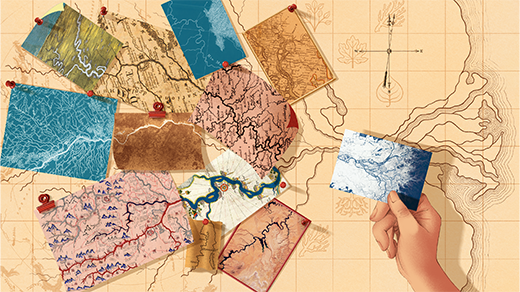
Rivers have captivated humanity for centuries, from the London Thames to the Texas Blanco. These winding waterways share a common thread: they all follow the same mathematical rule. University of Minnesota river scientist Chris Paola marvels at the patterns of branching networks found in rivers, trees, veins, train lines and highways.
Geomorphologists have long studied the geometry of river systems, dating back to the late 1800s. In 1957, USGS scientist John Hack discovered Hack’s law, which states that a river’s length is always proportional to its drainage area raised to the power of 0.6. This power law appears consistent worldwide, from small streams to mighty rivers.
The reason behind this seemingly universal constant has puzzled scientists for decades. The law contradicts the expectation that stream length would follow a different power law, like the square root of the drainage area. This discrepancy suggests that river networks are more energy-efficient when they elongate at larger scales, leading to a directional flow toward the ocean.
While the exact mechanism remains a mystery, Hack’s law has provided invaluable insights into the mathematical nature of river systems.
Written by urgent.news from Quanta Magazine's reporting — not their text. Machine-written — may contain errors; check the original before relying on it.