This Supernova Death of a Star Broke All the Rules
An unexpected way to go for a star 20 times the size of our sun The post This Supernova Death of a Star Broke All the Rules appeared first on Nautilus .
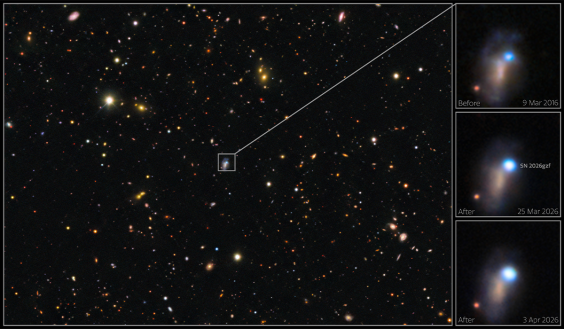
In March, the Einstein Probe telescope captured a cosmic occurrence of such significance that astronomers worldwide rushed to observe it further. This event, designated EP260321a, was a brief flash of X-rays 500 million light-years away, marking the beginning of a supernova explosion, now identified as SN 2026gzf. Within an hour of its detection, a dozen telescopes were directed at the star's location in the sky, where the supernova was unfolding.
This supernova proved to be a Type Ic-BL, a particularly explosive event where matter is ejected at extraordinary speeds. However, two unexpected aspects arose. Firstly, given the star's immense size, about 20 times that of our sun, the shock breakout was remarkably faint, though still observable. Secondly, astronomers anticipated seeing a narrow plasma jet launch from the supernova at near-light speeds, emitting a detectable gamma-ray burst.
Yet, this plasma jet never materialized. Astronomer Greg Zeimann from the McDonald Observatory in Texas proposed that the jet might have been "choked" by either the star's surface or the surrounding circumstellar material. The research on SN 2026gzf has unveiled crucial insights into the progression of different supernova types and how the most massive and violent ones can deviate from expected outcomes.
These findings have been published in two papers in The Astrophysical Journal Letters. Detecting shock breakouts is rare; the last confirmed sighting was in 2008. Zeimann explained that due to their brief duration and the lack of sensitive, wide-field monitoring in this region of space, these events have been historically challenging to detect.
However, with the advanced space-scanning capabilities of the Einstein Probe, such events will be more frequently identified, bringing these distant light dots closer to our understanding of the universe.
Written by urgent.news from Nautilus's reporting — not their text. Machine-written — may contain errors; check the original before relying on it.