US satellites hunting nuclear tests accidentally found first gamma-ray burst
Gamma-ray bursts are among the most powerful explosions observed in the universe. First accidentally detected by Vela satellites in 1967, they puzzled scientists for decades. Research later showed that these bursts come from distant cosmic events, including massive stars collapsing and neutron star mergers. Yet their powerful jets still hold mysteries.
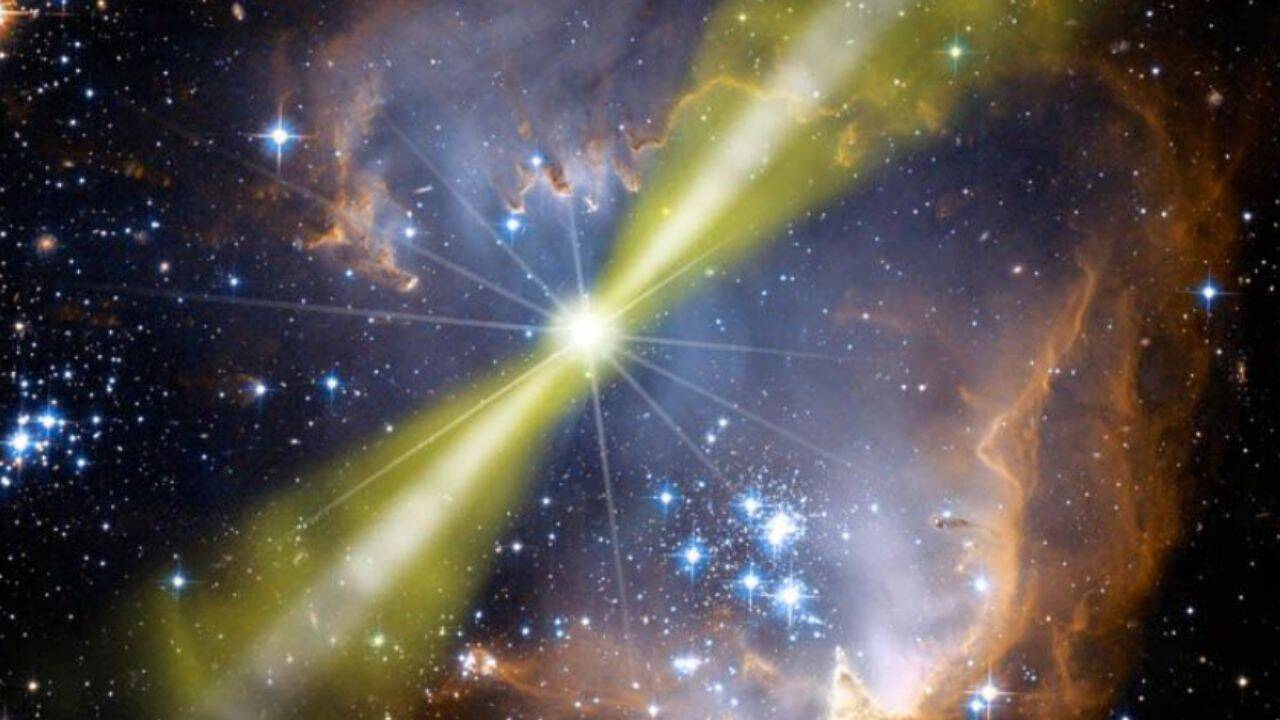
In July 1967, two US satellites named Vela 3 and Vela 4 were monitoring potential nuclear tests in violation of the Nuclear Test Ban Treaty. Instead, the satellites detected sudden, brief flashes of high-energy gamma rays emanating from space. For decades, the origin and nature of these mysterious gamma-ray bursts remained a perplexing enigma.
The Vela satellites, originally designed to detect signs of nuclear explosions, carried detectors that were sensitive to gamma rays and other forms of high-energy radiation. These detectors identified the fleeting gamma-ray bursts but scientists were unable to determine their source at the time, as they seemed to appear randomly across the sky and faded just as quickly as they appeared.
In 1973, Los Alamos scientists studied 16 such events recorded by the Vela satellites and concluded that the gamma-ray bursts were of cosmic origin. Further confirmation came from Soviet Konus satellites in 1974 and the Interplanetary Network (IPN) in 1976, a collaboration of spacecraft studying various celestial bodies that used triangulation to pinpoint the bursts' locations. However, even then, the exact origin of these bursts remained uncertain.
The Compton Gamma Ray Observatory, launched by NASA in 1991, revolutionized the study of gamma-ray bursts. Its Burst and Transient Source Experiment (BATSE) instrument detected over 2,700 bursts during its nine-year mission. This data revealed that the bursts were distributed uniformly across the sky, not concentrated in the plane of the Milky Way galaxy. This finding suggested that the bursts originated from regions far outside our galaxy, releasing an immense amount of energy.
In 1997, the Italian-Dutch BeppoSAX satellite detected an X-ray afterglow associated with a gamma-ray burst, providing a crucial tool for studying these events. Astronomers discovered that these bursts could release energy comparable to a supernova in mere seconds, with peak luminosities 100 billion times that of the Sun and a billion times more luminous than even the brightest supernovas.
Further research revealed that some gamma-ray bursts were linked to supernovas. Observations of specific bursts showed iron, silicon, sulfur, and argon elements, characteristic of supernovas. By 2003, NASA announced strong evidence supporting the theory that long-duration gamma-ray bursts resulted from the deaths of massive stars and the subsequent creation of black holes.
Written by urgent.news from Times of India's reporting — not their text. Machine-written — may contain errors; check the original before relying on it.