Scientists turn to sharks to improve hurricane predictions
Sharks may be used to gather data that helps scientists understand the potential intensity of a hurricane before it makes landfall.
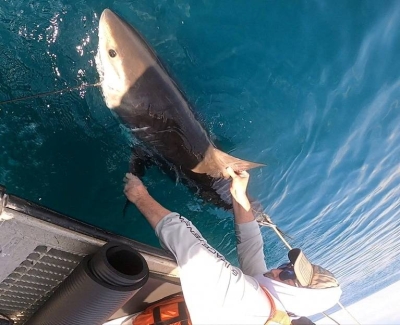
Sharks, often portrayed as fearsome antagonists in films, may soon play a role in improving hurricane predictions, according to researchers at the University of Delaware. Scientists are exploring the possibility of using sharks as mobile data gatherers, equipped with sensors to measure ocean conditions. These sensors, known as CTD tags, measure ocean conductivity, temperature, and depth, providing valuable information for oceanographic, atmospheric, and climate models.
The idea stems from the fact that sharks are abundant and widely distributed, making them an accessible and valuable data source. Researchers have identified several shark species, such as shortfin mako sharks, blue sharks, and juvenile great white sharks, as suitable candidates for this research in the North Atlantic. The tagging process involves attaching the sensors to the sharks' dorsal fins, allowing the data to be transmitted to satellites as the sharks surface.
Preliminary analyses have shown that the top layer of the ocean, known as the mixed layer, plays a crucial role in determining hurricane intensity. Warmer mixed layers contribute to stronger hurricanes by providing the heat that fuels these storms. By deploying shark-borne sensors, scientists hope to gain a better understanding of ocean conditions and improve hurricane forecasts, ultimately helping communities along the U.S. East Coast better prepare for and mitigate the impacts of these powerful storms.
Written by urgent.news from Japan Times's reporting — not their text. Machine-written — may contain errors; check the original before relying on it.
This story
This is one outlet's version. Read the fullest account.
- US scientists turn to sharks for help with hurricane prediction france24.com
- Scientists turn to sharks for better hurricane predictions thehindu.com
- Scientists turn to sharks to improve hurricane predictions channelnewsasia.com