Van Gogh’s exuberant ‘Tarascon Stagecoach’ will go on show in New York
The masterpiece, alongside 62 other works given by the Pearlman family, is coming on tour from Los Angeles
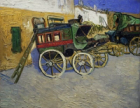
Adventures with Van Gogh, a weekly blog penned by Martin Bailey, The Art Newspaper's trusted correspondent and Van Gogh expert, recently reported on the forthcoming exhibition of the painter's renowned "Tarascon Stagecoach" at New York's Museum of Modern Art (MoMA). Originally published on 24th October 2025 and updated on 7th August 2026, this blog post details the moving journey of this prized masterpiece.
The "Tarascon Stagecoach," painted in October 1888, is one of the 63 works that the Henry and Rose Pearlman Foundation is donating to leading American museums. Initially unveiled at Los Angeles County Museum of Art (LACMA), it will now venture to the Brooklyn Museum in a traveling exhibition titled "Cézanne to Modigliani: Gifts of Modern Art from the Pearlman Collection" (running from 2nd October 2027 to 18th April 2027). The final destination is New York's MoMA, with the remaining Pearlman works to follow.
Vincent painted this stagecoach in the heart of Arles, depicting a horse-drawn carriage outside the Auberge de la Poste in the city's walled boulevard. As the coach regularly departed for Tarascon, a town 15km to the north, Van Gogh himself had rode the same carriage or one similar in October 1888. The painting was sketched by Van Gogh in a letter to his brother Theo, who described the vivid colors: "Simple foreground of grey sand.
Background very simple too, pink and yellow walls with windows with green-louvered shutters, corner of blue sky. The two carriages very colourful: green, red, wheels yellow, black, blue, orange."
The painting's impact is attributed to the prominent red sign reading "Service de Tarascon." In October 1888, Van Gogh expressed his exhaustion to Theo, saying, "I'm knocked out from painting this Tarascon diligence and I can see that I haven't a head fit for drawing. I'm off to have supper." That month, Van Gogh was reading Alphonse Daudet's satirical novel, "Tartarin de Tarascon," which inspired his depiction of the stagecoach.
A year after completing the painting, Van Gogh promised Theo he would make a copy, but never followed through. Theo eventually left the original with avant-garde art dealer Père Julien Tanguy. In the early 1890s, Tanguy (or his widow) sold the piece to Italian sculptor Medardo Rosso, who initially hung it in his studio but later moved it to the attic due to criticism. In 1895, Rosso's friend, Uruguayan artist Milo Beretta, received the painting and was the first to bring a Van Gogh to the Americas.
The painting remained with Beretta's six daughters, who stored it in a bank vault until selling it to Argentinian dealer Paula de Koenigsberg in 1935. De Koenigsberg then acquired Tarascon Stagecoach for Henry Pearlman, whose foundation donated it to LACMA in 1950. The self-made New York entrepreneur amassed an impressive collection of Impressionist, Post-Impressionist, and Expressionist works during his lifetime.
Now on its way to MoMA, this iconic painting offers a glimpse into Van Gogh's artistic process and his fascination with the rugged, colorful world of Tarascon and its surrounding landscapes.
Written by urgent.news from The Art Newspaper's reporting — not their text. Machine-written — may contain errors; check the original before relying on it.