Sperm Whales Seem to Change Their Calls When Ships Are Near, Highlighting the Implications of Underwater Noise Pollution
Several of the huge cetaceans living in the eastern Caribbean Sea shortened the intervals between their clicks and used one click pattern more than another when vessels were around, according to a new study
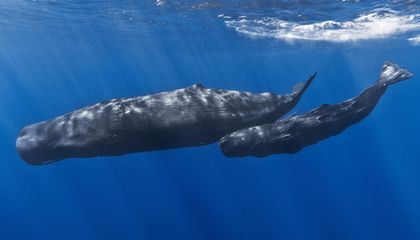
Recent research reveals sperm whales reacting to shipping vessels by altering their vocalizations, which could indicate the impact of underwater noise pollution. Project CETI scientists, who aim to translate cetacean communication, have uncovered that the social creatures adjust their "phonetic alphabet," composed of codas or series of clicks, when confronted with noise from boats.
In a study published in Ecological Informatics on June 18, the researchers reported that sperm whales shorten the intervals between clicks and favor one type of coda over another when ships are nearby. Co-author David Gruber explains that the whales either might be discussing the ships or experiencing voice changes due to their presence.
Examining over 1,000 codas from 13 sperm whales off the Caribbean island of Dominica, the team compared a-codas and i-codas, which resemble the "a" and "i" vowels in human speech. They discovered that the whales emitted more a-codas than i-codas and that a-codas were quicker, with shorter interclick intervals. Nathan Merchant, an underwater bioacoustics expert, emphasizes that this study reveals fine-scale content changes in the calls, adding nuance to the ongoing conversation about underwater noise's impact on cetaceans.
The findings are especially significant as shipping noise has doubled every decade since 1960, leading to potential hearing loss, stress responses, and disruptions in feeding and breeding for marine animals. Michelle Fournet, an acoustic ecologist, notes that anthropogenic noise has emerged in the ocean on human timescales, while cetaceans have evolved on evolutionary timescales, prompting the question of whether the codas' changes benefit the whales.
Written by urgent.news from Smithsonian's reporting — not their text. Machine-written — may contain errors; check the original before relying on it.