South Korea space agency shares Moon images after SpaceX rocket debris crash
Seoul's lunar orbiter captured images of the Moon before and after part of SpaceX's rocket hit its surface on Wednesday.
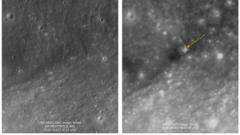
The Korean Aerospace Administration (KASA) has released images of the Moon following the impact caused by a piece of a SpaceX rocket on Wednesday. The Danuri lunar orbiter captured images of the lunar surface before and after the collision, which occurred at approximately 06:35 GMT.
The rocket debris struck the Moon at a speed of about 5,400mph (8,700km/h). SpaceX has clarified that the impact was not intentional; reusable Falcon 9 rockets are designed to return part of the rocket to Earth and shed other sections in space. The empty upper stage of the Falcon 9 rocket, which scientists predicted would collide with the Moon, is comparable to the size of a five-story building and weighs around 4,000kg (630st) on Earth.
Astronomers, including Matt Bothwell from the University of Cambridge, expressed concerns about space debris, noting that space is becoming increasingly crowded. Each year, more objects are launched into orbit, potentially making it difficult to navigate Earth's orbit in the coming decades due to the congestion, warned Bothwell.
This particular Falcon 9 rocket had been in orbit since January of the previous year, when it launched from Florida. The same booster section from the January 2025 mission is scheduled to embark on its 18th flight on August 10. SpaceX intends to launch 29 Starlink satellites to low-Earth orbit with this mission. The Falcon 9 rocket that launched from Florida in January was carrying two lunar landers into space.
Its objective was to propel the upper stage forcefully enough to send both landers out of Earth's orbit and onto a trajectory towards the Moon. The spent stage is now drifting in a long, looping orbit that swings towards and away from the Moon, gradually gaining speed due to the gravitational pull of Earth, the Moon, and the Sun.
Despite the impact being visible during broad daylight in many parts of the world, the faint flash produced by the striking rocket part would have been too subtle to detect, even with a high-powered telescope.
Written by urgent.news from BBC Science's reporting — not their text. Machine-written — may contain errors; check the original before relying on it.
This story
This is one outlet's version. Read the fullest account.
- North Korea launches unidentified projectile toward waters off its east coast, South Korea says apnews.com
- North Korea fires at least one ballistic missile into sea, South Korea's military says euronews.com
- South Korea space agency shares Moon images after SpaceX rocket debris crash bbc.co.uk
- (3rd LD) N. Korea fires short-range ballistic missile toward East Sea: military en.yna.co.kr