What leeches reveal about movement
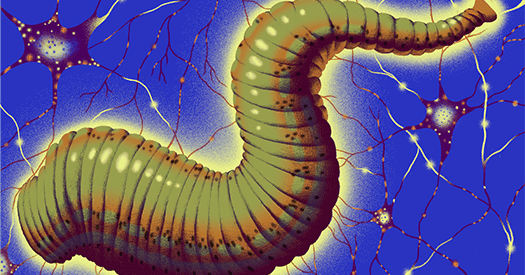
Lidia Szczupak turned to animals to explore how the nervous system coordinates movement. When Lidia Szczupak found herself stalled in her scientific research, she turned to the medicinal leech Hirudo verbana to help her move forward. She had been studying how neurons determine the characteristics of fast and slow muscle fibers in toads.
“It was a failure,” says Szczupak, a professor in the department of physiology and molecular biology at the University of Buenos Aires. The work involved making cell cultures using fibers dissected from animals collected in her natural environment. But due to the sociopolitical climate at the time in Argentina, she lacked the infrastructure and necessary tools to carry out these studies and the cultures often became contaminated.
“It was a very low point [in science in Argentina],” she says, recalling her frustration. But then she met John Nicholls, a neuroscientist at Stanford University and author of the book Neurobiology of the Leech, which argues that invertebrate leeches are a useful model for studying the neuronal basis of locomotion, among other complex phenomena.
Nicholls inspired Szczupak to attend a course on the animal at the Marine Biological Laboratory and, once convinced of the worm's potential, she changed her model. Leeches have 21 central body segments—or ganglia—each with its own set of sensory and motor neurons, and “each segment is exactly like the next,” says Szczupak. Furthermore, “the movements are very clear; the neurons are giant and easy to study.”
The simplicity of this body and motor plan makes it easy to disrupt neurons and circuits and allows researchers to discover how they contribute to movement. For example, even without a brain or sensory information, individual ganglia can produce rhythmic motor activity and coordinate with each other to create a global network that drives movement, Szczupak found.
But movement is also controlled locally: each segment uses inhibitory signals to modulate the activity of motor neurons, which determines specific phases of movement, she and her team reported earlier this year.
Szczupak spoke with The Transmitter about how leeches maintain balance, the movements they can make without their brain, and what their simplicity can bring to neuroscience. This interview has been edited for brevity and clarity.
The Transmitter: What makes leeches a good model for studying the nervous system?
Lidia Szczupak: What's special about the leech is that it has a clear motor pattern that can be studied at the level of one segment, because one segment has to do the same as the next. When you have information about one segment, you have information about the whole organism. But for the animal to survive and move around, it has to coordinate those segments.
TT: What specific aspect of motor control are you interested in?
LS: Leeches move either by swimming in water or crawling on surfaces. To do that, the animal has to generate a motor pattern that, for each segment, has to stretch and contract. It does it for one segment, but then it has to be coordinated in an anteroposterior organization so that the whole animal can contract and stretch in a concerted manner. I study how the nervous system coordinates the signals that allow the animal to move.
TT: What have you learned about how leeches move?
LS: The animal organizes its movement by taking into consideration the necessary measures to maintain balance. The animal stretches its front part, but leaves its center of mass in the back until it reaches a position where it feels safe and then moves its center of mass. The animal doesn't just mechanically stretch and contract without any consideration beyond the repetition of movements.
TT: How does the nervous system coordinate that movement?
LS: One might think that the brain coordinates all the ganglia. We discovered that's not the case. Many of the coordination signals are generated by the chain of ganglia without the brain. The signals that produce that coordination are transmitted both forward and backward. Although the animal advances its movement from anterior to posterior—as if the anterior ganglia tell the posterior ganglia what to do—the posterior ganglia also send the message to the anterior ganglia: “Don't start your movement until I finish mine.”
TT: How big is the leech community and what else is the animal used for?
LS: At the time I entered as a postdoctoral researcher, the community was very small but active. Unfortunately, today the number of laboratories using the leech to study neurophysiological principles is very small. Many in the community have retired, including my postdoctoral mentor William Kristan. There's a group in Mexico working on how cells release neurotransmitters, but it's difficult, especially with the lack of genetic tools.
Right now, science in general in Argentina is very difficult; science with the leech is even more difficult.
TT: What tools would help researchers study leeches?
LS: A big step forward would be to get neurons to express calcium sensors, which is trivial in Drosophila since you can make any cell express calcium sensors. In the leech, that's very difficult because the embryos are very small and have never been cultured outside their cocoon, making it hard to inject them with reagents.
TT: What do you think leeches can bring to neuroscience?
LS: If you want to understand how neural networks really work, you need a simple system. The leech has a very simple nervous system, and that's what makes it so attractive.
Translated by urgent.news. Machine-written — may contain errors; check the original before relying on it.