Crystal made from 13-sided 'einstein' shape bends light in ways nobody imagined
Scientists carved a 13-sided shape called an "einstein" into a chip and discovered that it steers light in ways no other crystal does.
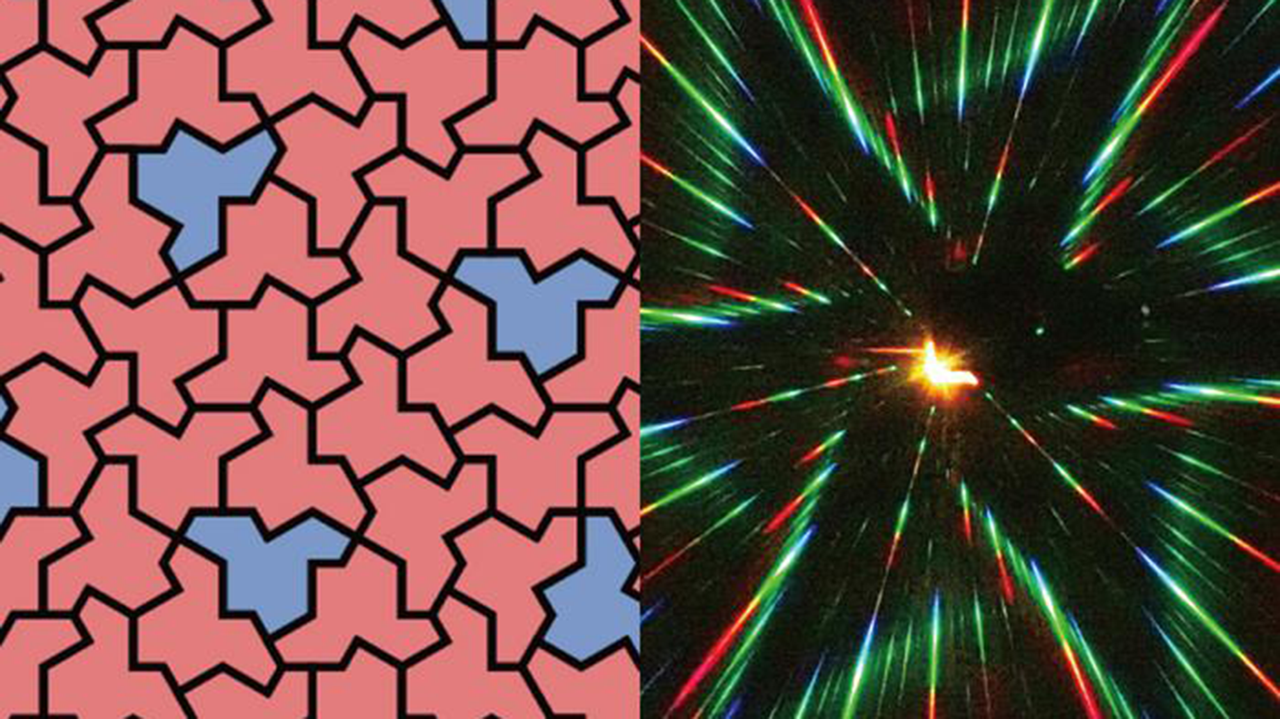
In a groundbreaking study published on July 29 in the journal Nature Communications, physicists have constructed a crystal from a rare 13-sided "einstein" tile, a shape that mathematicians have been searching for years without success. The researchers arranged these nanoscale holes into a pattern of a photonic crystal, a material designed to manipulate light in unprecedented ways.
Upon shining a laser at the crystal, it produced an unusual swirling, pinwheel-shaped scattering pattern that reacted differently depending on the direction of the incoming light's spin.
The discovery solves a long-standing mathematical puzzle, known as the "einstein problem," which asks whether a single shape can cover a flat surface endlessly without ever repeating its pattern. In 1970, Roger Penrose had shown that two different shapes could accomplish this when used together. However, in 2023, David Smith and his collaborators finally found the elusive 13-sided shape, which they dubbed the "Smith hat."
Yuto Moritake, a physicist at the University of Tokyo, stumbled upon the Smith hat tile in a popular science book in 2024. Intrigued by its unique, never-repeating arrangement, Moritake decided to incorporate it into a photonic crystal structure. Using two precision manufacturing techniques - electron beam lithography and etching - Moritake and his team punched hundreds of thousands of tiny holes, each just 100 nanometers in radius, into a thin film of silicon nitride.
This resulted in a chip approximately half a millimeter across, which was then tested for its light-controlling properties.
The scattering pattern produced by the crystal was a striking pinwheel shape that remained consistent regardless of the laser's position on the chip. This confirmed that the structure possessed the long-range, predictable order characteristic of a quasicrystal, a material whose atoms (or in this case, holes) follow an orderly pattern that never repeats.
The crystal's asymmetry, due to the Smith hat tile's lack of mirror symmetry, led to an unexpected and surprising circular polarization dependence - a property not found in ordinary quasicrystals. This discovery opens up promising avenues for controlling light within photonic chips, potentially revolutionizing optical communications and optical computing technologies.
Written by urgent.news from Live Science's reporting — not their text. Machine-written — may contain errors; check the original before relying on it.