How Bubbles Reshape Air-Sea Gas Exchange
Bubbles produced by breaking waves provide an important but often overlooked pathway for exchanging carbon dioxide, oxygen, and other gases between the ocean and atmosphere.
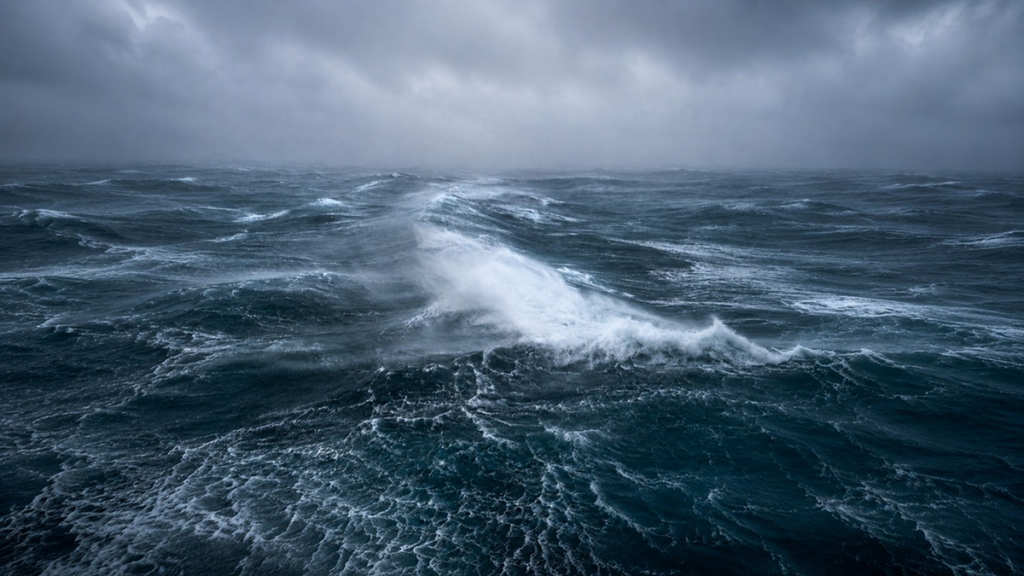
Air-sea gas exchange is the process by which gases move between the atmosphere and the ocean. This exchange plays a crucial role in regulating climate, ocean biogeochemistry, and the global carbon cycle. Bubbles contribute significantly to this exchange, influencing the rate and nature of gas transfer.
Bubble-mediated gas transfer occurs when waves break, creating clouds of bubbles that act as conduits for gas movement between the atmosphere and seawater. This process is distinct from interfacial transfer, which directly occurs across the air-water boundary. Bubble-mediated transfer is influenced by factors such as wave breaking, gas solubility, and the compression of gases within bubbles, leading to unique characteristics compared to interfacial transfer.
Studying bubble-mediated transfer is challenging due to its complexity. Researchers employ a combination of laboratory experiments, field observations, and physical models to unravel the underlying mechanisms. Laboratory wind-wave tanks allow controlled experiments, while field techniques such as measuring gas solubility and turbulent gas fluxes provide valuable data. Physical models help connect field observations and laboratory experiments, offering independent constraints on bubble-mediated gas exchange.
Despite these efforts, several important research questions remain unanswered. Scientists seek to better understand the underlying processes, improve observation techniques, and accurately quantify the contribution of bubble-mediated transfer to air-sea gas exchange. By addressing these questions, researchers aim to enhance our understanding of the role of bubbles in regulating climate and ocean biogeochemistry.
Written by urgent.news from Eos's reporting — not their text. Machine-written — may contain errors; check the original before relying on it.