Summer 2026 Journal of Economic Perspectives Freely Available Online
I have been the Managing Editor of the Journal of Economic Perspectives since the first issue in Summer 1987. The JEP is published by the American Economic Association, which decided back in 2011–to my delight–that the journal would be freely available online, from the current issue all the way back to the first issue. You can download individual … Continue reading Summer 2026 Journal of Economic…
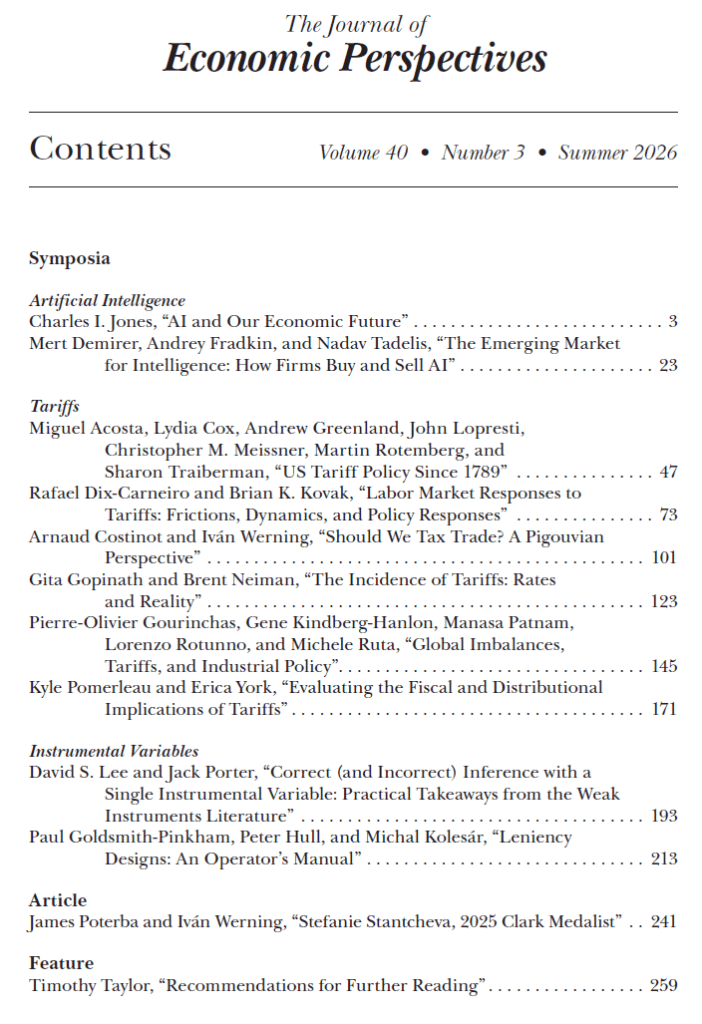
The Journal of Economic Perspectives (JEP), published by the American Economic Association, has been freely available online since 2011. The Summer 2026 issue (issue #157) is now accessible on the site. The Table of Contents and abstracts for each paper in the issue are provided, with direct links to the full articles. An upcoming blog post will delve into specific papers in more depth.
The first paper in the issue, "AI and Our Economic Future" by Charles I. Jones, explores the transformative impact artificial intelligence may have on the modern economy. Jones argues that while economic growth has remained stable at about 2 percent per year for the past 150 years, automating intelligence could potentially accelerate growth rates.
However, he warns that this acceleration may be hindered by the existence of "weak links" in human productivity, such as the need for humans to make decisions on what tasks to automate. Jones also discusses the potential risks associated with powerful AI systems, which could be misused for harmful purposes.
The second paper, "The Emerging Market for Intelligence: How Firms Buy and Sell AI" by Mert Demirer, Andrey Fradkin, and Nadav Tadelis, examines the growing business-to-business market for large language model inference. The authors found that the number of commercially available AI models has expanded rapidly, with prices falling a thousandfold.
They also noted that the market is highly dynamic, with frequent changes in leading models and creators. The authors place these patterns in historical context alongside other general-purpose technologies.
The third paper, "US Tariff Policy since 1789" by Miguel Acosta, Lydia Cox, Andrew Greenland, John Lopresti, Christopher M. Meissner, Martin Rotemberg, and Sharon Traiberman, revisits the evolution of US tariff policy using a comprehensive dataset. The authors document the shift from Congressional setting to multilateral negotiation, the growth in tariff code granularity, and the importance of specific tariffs throughout US history.
They also discuss the implications of this relationship for interpreting past liberalization episodes and identifying tariff effects.
The fourth paper, "Labor Market Responses to Tariffs: Frictions, Dynamics, and Policy Responses" by Rafael Dix-Carneiro and Brian K. Kovak, reviews the evidence and modeling frameworks used to understand the effects of trade and tariff policy on labor markets. The authors emphasize the presence of adjustment frictions in labor markets, which evolve slowly over time. They discuss policies aimed at mitigating costs to workers and ensuring that the benefits of trade are shared more equitably.
The fifth paper, "Should We Tax Trade? A Pigouvian Perspective" by Arnaud Costinot and Iván Werning, develops a Pigouvian perspective on optimal trade policy. The authors unify a range of rationales for taxing trade, from classical optimal tariff arguments to contemporary concerns about global carbon emissions and geopolitics. They also clarify when trade policy intervention is warranted and when alternative domestic instruments should be employed.
Lastly, "The Incidence of Tariffs: Rates and Reality" by Gita Gopinath and Brent Neiman examines the impact of recent statutory tariff rate increases on US import prices. While shipping lags, exemptions, and enforcement gaps have moderated the actual implemented rates, tariff pass-through to import prices remains substantial at 92 percent. The authors discuss the costs borne by the United States as a result of these tariff changes.
Written by urgent.news from Conversable Economist's reporting — not their text. Machine-written — may contain errors; check the original before relying on it.