100-Million-Year-Old Fossil Preserves an Ichthyosaur That Ate a Pterosaur Before Becoming Food for a Giant Predator
Discover a unique fossil find from the Australian Outback detailing how a large ichthyosaur preyed on a pterosaur before it became prey itself, a first of it's kind find.
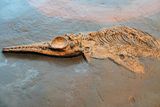
In 2019, a remarkable fossil discovery was made near Richmond, Queensland, Australia, by Mike and Cathy Freeman, Gary and Barb Flewelling, and Gary and Barb Flewelling. The fossil, nicknamed "Bag of Bones" or B.O.B., was initially thought to contain remains from various marine creatures. However, it was not until three years later, when Kevin Petersen, a curator at Kronosaurus Korner, revisited the fossil site, that the true significance of the find was revealed.
Using advanced technology, researchers from the Australian Nuclear Science and Technology Organization (ANSTO) performed a synchrotron CT scan on the fossil and discovered pieces of a pterosaur inside the ichthyosaur's fossilized stomach contents. This marks the first known evidence of an ichthyosaur consuming a pterosaur, a prehistoric flying reptile.
The ichthyosaur, belonging to the Platypterygius australis species, measured 19 to 22 feet in length, and the fossil also displayed evidence of attacks or scavenging from a giant predator known as Kronosaurus queenslandicus. This discovery sheds light on the complex food web of ancient marine reptiles and their environment, which flourished over 100 million years ago in the ancient Queensland sea.
Written by urgent.news from Discover Magazine's reporting — not their text. Machine-written — may contain errors; check the original before relying on it.