Iran War: Trump: Attacks on Iran Cancelled - "Outlines of an Agreement"
The US military was reportedly on the brink of a massive wave of attacks on targets in Iran. Now, Trump apparently wants to forego this - provided his conditions are met quickly.
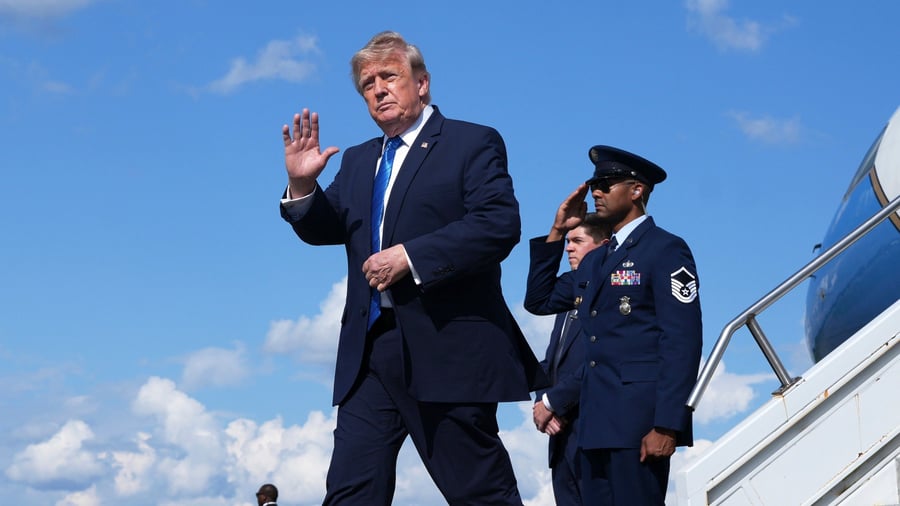
US President Donald Trump has postponed a new wave of military attacks on Iran, citing alleged progress in diplomatic efforts to reach an agreement. In a post on his Truth Social platform, Trump said that a deal must be reached quickly. He claimed that the US military was ready to launch an attack "like it hasn't happened since World War II".
However, Iran and other countries in the region had asked him to hold off, as there were now "outlines of an agreement". This included the complete opening of the Strait of Hormuz and an end to the nuclear threat from Iran, according to Trump. Israel would also adhere to the agreement and not attack Iran again for now.
Several US media outlets had previously reported on an imminent large-scale attack on targets in Iran, which was also expected to include attacks on Iran's energy infrastructure.
In his post on Truth Social, Trump stated that Israel was joining him in his efforts to end the war by implementing the ceasefire agreement. However, Israel did not publicly comment on Trump's announcement.
Trump urged the mediators to "get to work and GET IT DONE". He did not provide further details on the alleged diplomatic breakthrough.
The Iranian news agency Fars News, which is close to the Revolutionary Guard, reported that claims that Tehran had agreed to open the Strait of Hormuz were false, citing an unnamed negotiator. However, the agency did not deny that negotiations were taking place.
This is not the first time Trump has canceled a planned attack, citing progress in negotiations on a ceasefire. In the past, he has also threatened Iran with devastating attacks, saying in April: "A whole civilization will die tonight".
Iran's Foreign Minister, Abbas Araghchi, did not initially comment on the negotiations. However, he did speak to Pakistani Army Chief Asim Munir and his Saudi and Turkish counterparts, Faisal bin Farhan Al Saud, on Saturday.
Pakistan and Turkey, along with Qatar, are playing a key role in mediating, while Oman is trying to resolve the conflict over the Strait of Hormuz. Saudi Arabia is also pushing for a diplomatic solution, which may have contributed to Trump's change of heart.
According to a report by the US news site Axios, Saudi Crown Prince Mohammed bin Salman spoke with Trump on Saturday to express the concerns of the Sunni kingdom about the planned new attack. Citing US sources familiar with the conversation, Axios reported that the crown prince urged Trump to de-escalate.
Iran has not confirmed an alleged breakthrough in negotiations. The military has taken a hardline stance, with acting Defense Minister Majid Ibn-e-Reza stating that Iran would remain vigilant in the face of concrete threats from the US.
Ibn-e-Reza told the Mehr News agency, which is close to the security apparatus, that Tehran took Trump's threats seriously, even if they were part of psychological warfare. "We will not be caught off guard or stand idly by."
It would not be the first time Trump has spoken of a breakthrough that has later been denied by other parties or proven unrealistic.
Since the US and Israel attacked Iran on February 28, Trump has repeatedly announced a halt to attacks on the country, only for the mutual attacks to resume each time.
The conflict escalated again last week, after Iran attacked US forces in the Middle East, and the US retaliated in the night of Thursday.
In June, Washington and Tehran signed a framework agreement that included a ceasefire and the opening of the Strait of Hormuz. However, it never came to a full opening, and the initial increase in shipping traffic in the strait was again almost brought to a standstill by new attacks.
Tehran is using the de facto blockade, which leads to higher global oil and gas prices, as leverage against Trump.
Trump had initially said the war would last only a few weeks, but it has now been six months. Support for the military deployment in the Middle East is dwindling, even among Republicans.
Trump had campaigned on a promise to reduce the everyday costs for Americans, but since the start of the Iran war, fuel costs have risen. Additionally, the stockpile of defense missiles has been significantly depleted by the use in Iran.
Experts warn that a lack of defense missiles could mean that not all Iranian or allied attacks can be repelled.
The US military has renewed its naval blockade as leverage against Iran, aiming to cut off the country from revenue from crude oil exports. Oil exports are the most important source of income for the Islamist power apparatus in Tehran.
The framework agreement from June between the US and Iran also provided for negotiations on Iran's nuclear program.
Iran's Foreign Minister Abbas Araghchi warned on Saturday against a new military escalation in the war with the US, in a conversation with his Saudi counterpart Faisal bin Farhan.
The powerful armed forces of his country would react resolutely to any act of aggression.
Translated by urgent.news. Machine-written — may contain errors; check the original before relying on it.
This story
This is one outlet's version. Read the fullest account.