What Killed Galaxies in the Early Universe?
Galaxies in the infancy of the Universe are the building blocks of more modern galaxies. They began as small "shreds" of material that coalesced over time to form larger ones. That's why astronomers use observatories such as the James Webb Space Telescope (JWST) to study the young Universe. The light from those early objects appears in the infrared part of the spectrum, which JWST is tuned to see.
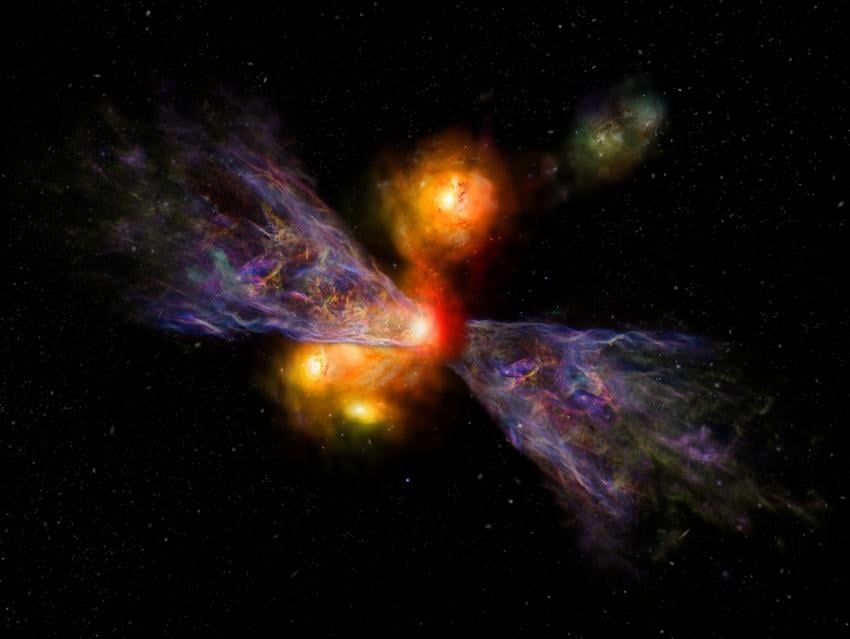
The story behind early galaxies in the Universe centers on understanding why some turned off starburst activity, leaving behind massive, quiet galaxies. Observatories like the James Webb Space Telescope (JWST) help study these young galaxies, which emit light in the infrared spectrum. Recent JWST discoveries have revealed massive, quiescent galaxies around 1-2 billion years old, a period of galaxy formation and collisions.
These quiescent galaxies are not dead, but instead experience bursts of star formation before going quiet. The mystery lies in what turns off this starburst activity. Astronomers have proposed various theories, including early dark energy activity causing rapid growth and death. A new study finds that some early galaxies are less massive than they first appeared, with black holes making them seem brighter and larger.
The culprit behind the quenching of star formation in these galaxies is a powerful wind that occurs during galaxy collisions. This wind, triggered by galaxy mergers, ejects material twice as fast as the galaxy forms stars, effectively choking off further star birth. This process could explain why many early galaxies appear massive and dead.
Galaxies like CRISTAL-02, discovered by JWST, are forming stars twice as fast as similar galaxies, but their powerful wind is driving gas away, leading to rapid quenching. Astronomers suggest reevaluating simulations that underestimated early galaxy diversity. The discovery supports the idea that galaxy collisions and rapid growth are widespread in the early Universe, with many galaxies experiencing this wind-driven quenching.
Further observations, focusing on dusty regions and gas plumes, are needed to refine models of early galaxy formation and evolution.
Written by urgent.news from Universe Today's reporting — not their text. Machine-written — may contain errors; check the original before relying on it.