Johannes Kepler, not Newton or Einstein, is science’s best role model
For a great many people in the world, the hardest words to say are simply these three: “I was wrong.” It’s as though simply admitting you were mistaken about something — even though the only way we learn is by making an attempt, often resulting in a sub-optimal outcome, especially when you’re doing it for the first time or with incomplete knowledge — is somehow a personal failing, or even an…
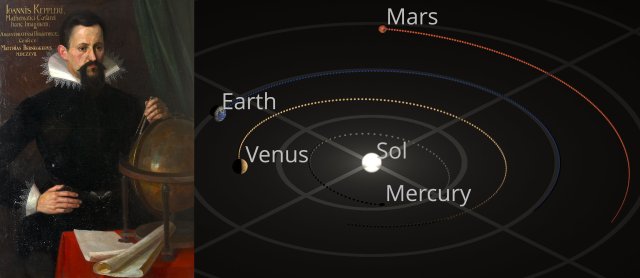
Johannes Kepler, a 17th-century astronomer, is widely regarded as the best role model for scientists in history. Unlike many of his contemporaries, Kepler embraced the evidence that contradicted his initial beliefs, demonstrating an unwavering commitment to scientific truth. Kepler's scientific journey began with the geocentric model, which placed Earth at the center of the universe.
However, he later realized that this model was incorrect and shifted towards the heliocentric model, which positioned the Sun at the center of our solar system.
One of Kepler's most significant contributions to science was his discovery of the elliptical orbits of planets. Prior to Kepler, the prevailing belief was that planets moved in perfect circles around the Sun, as proposed by the Greek astronomer and mathematician, Nicolaus Copernicus. However, Kepler's meticulous observations and calculations revealed that planets actually followed elliptical paths, with the Sun at one focus of the ellipse.
This groundbreaking discovery laid the foundation for modern celestial mechanics and revolutionized our understanding of the cosmos.
Kepler's commitment to scientific integrity was evident in his willingness to accept and incorporate the evidence that contradicted his initial beliefs. Despite facing considerable resistance and skepticism from the scientific community, Kepler remained steadfast in his pursuit of truth. His story serves as a powerful example of how embracing contradictory evidence and remaining open to change can lead to groundbreaking discoveries and scientific progress.
In contrast to Kepler's approach, many other prominent figures in science, such as Albert Einstein, Arthur Eddington, Newton, and Fred Hoyle, struggled to accept evidence that contradicted their established theories. These scientists, despite their genius, became entrenched in their beliefs, often due to personal investment and years of dedicated effort. However, their failure to adapt to new evidence ultimately hindered their scientific progress and prevented them from fully embracing the truth.
Johannes Kepler's legacy as a scientist who embraced contradictory evidence and remained open to change is an invaluable lesson for all researchers. By following Kepler's example, scientists can foster a culture of intellectual honesty, humility, and continuous learning, ultimately advancing our collective understanding of the natural world.
Written by urgent.news from Big Think's reporting — not their text. Machine-written — may contain errors; check the original before relying on it.