Rare fossil reveals new dinosaur species with a spiky tail in Gujarat’s Kachchh Basin
Research Matters Staff Writer(s) Mumbai 24 Jul 2026 Scientists have discovered a new species of long-necked dinosaur in western India that possessed a unique, horn-like tail crest. The dinosaur, named Ceratocaudia antiqua , was identified by a team of researchers from the Indian Institute of Technology Bombay (IIT Bombay) and Birbal Sahni Institute of Palaeosciences following excavations in the…
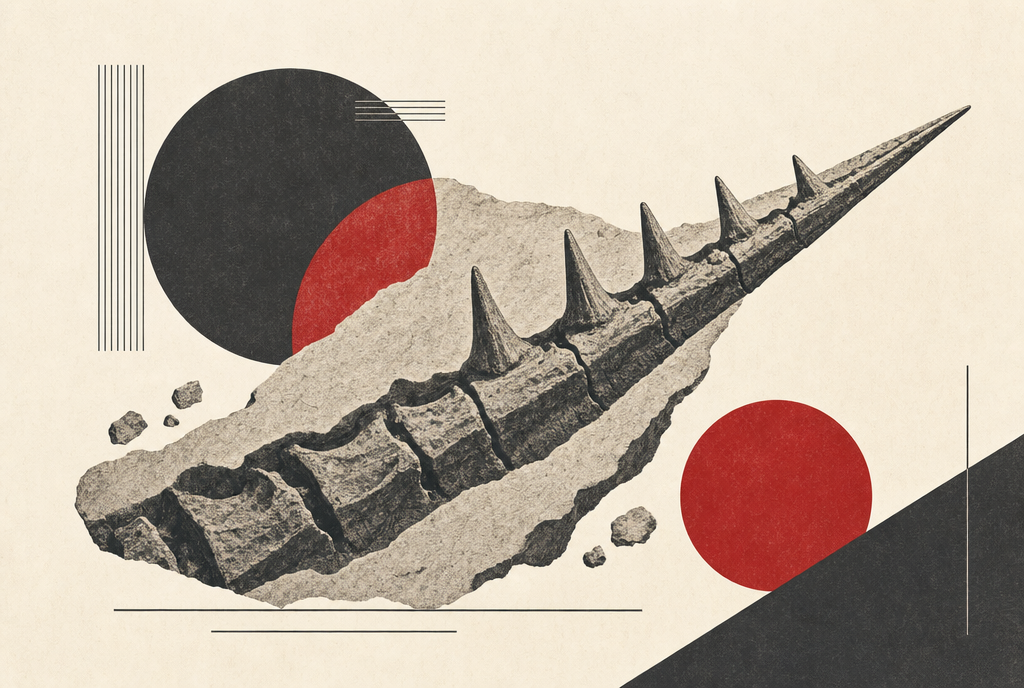
In a remarkable discovery in western India's Kachchh Basin, scientists have unearthed a new species of long-necked dinosaur, Ceratocaudia antiqua. This diminutive giant, measuring about seven meters in length, lived around 170 to 180 million years ago during the Jurassic period. Named for its unique horn-like tail crest and ancient features, this dinosaur was significantly smaller than its more renowned 20-meter-long relatives like Brachiosaurus.
The team of researchers from IIT Bombay and Birbal Sahni Institute of Palaeosciences identified Ceratocaudia antiqua through excavations of the Kaladongar Formation near Amrapar in Gujarat's Kutch district. Using advanced 3D laser scanning and CT technology, they were able to reconstruct the dinosaur's anatomy. The unique tail crest, a curved horn-like structure atop its front tailbones, and distinctive bone characteristics such as a notch on its neck vertebrae, set this species apart from its closest relatives.
Interestingly, the fossils also revealed signs of advanced age, including bone remodelling and early arthritis in its leg bones, suggesting Ceratocaudia antiqua had lived a notably long life for a dinosaur. Its tail vertebrae display a rare transition from flat-ended joints to "ball-and-socket" joints near the tip, a trait more commonly seen in later dinosaur species.
The dinosaur's genus name, Ceratocaudia, is derived from the Greek words 'cerato' (meaning horn) and 'caud' (meaning tail), while its species name, 'antiqua', signifies its ancient and early evolutionary status.
This discovery is a significant addition to the evolutionary puzzle for paleontologists, suggesting that Jurassic-era dinosaurs had a broader and earlier global presence than previously known. Prior to this find, India's Jurassic record of such dinosaurs was scarce. Ceratocaudia antiqua not only stands as the earliest known member of its lineage in India but also as one of the oldest globally, demonstrating that even the most colossal creatures of the past harbored a diversity of smaller, unique species.
Written by urgent.news from Research Matters India's reporting — not their text. Machine-written — may contain errors; check the original before relying on it.
This story
This is one outlet's version. Read the fullest account.