Tired of the rat race? China’s villages want you and your AI start-up
In a sleek library next to wheat fields in Shanghai’s farming suburbs, a dozen millennials work…
In a charming library adjoining wheat fields in Shanghai’s farming outskirts, a group of young professionals is leveraging artificial intelligence to revitalize this village filled mostly with retirees. Authorities in China are transforming sparsely inhabited areas into hubs for artificial intelligence talent, enticing mid-career tech workers to escape the hustle and bustle of urban life.
In April, the village of Caojing, located in an idyllic nature reserve 60 kilometers south of central Shanghai, became one of many locations offering subsidies of millions of yuan to small-scale AI ventures. Start-ups relocating to Caojing receive complimentary access to shared office space, grants up to 10,000 yuan, and a week of complimentary housing.
These AI-focused regions represent a result of Beijing’s “AI Plus” policy strategy, aiming to integrate the technology into nearly every facet of learning and everyday life.
38-year-old Wind Liu relocated his family to Caojing’s Shuiku village three months ago. He shares his home with around 30 other residents in dormitories previously occupied by families. The village serves as a haven for AI-driven firms, attracting a diverse group of digital nomads. Liu, an English teacher, utilizes the Chinese AI video generation tool Seedance to create animated vocabulary lessons featuring characters from American TV shows, sharing them on social media.
He utilizes the technology to maintain a work-life balance, avoiding the demanding “996” lifestyle prevalent in Chinese megacities. Liu states, "I need to be online… I need to get clients. I definitely need to have a relationship with technology."
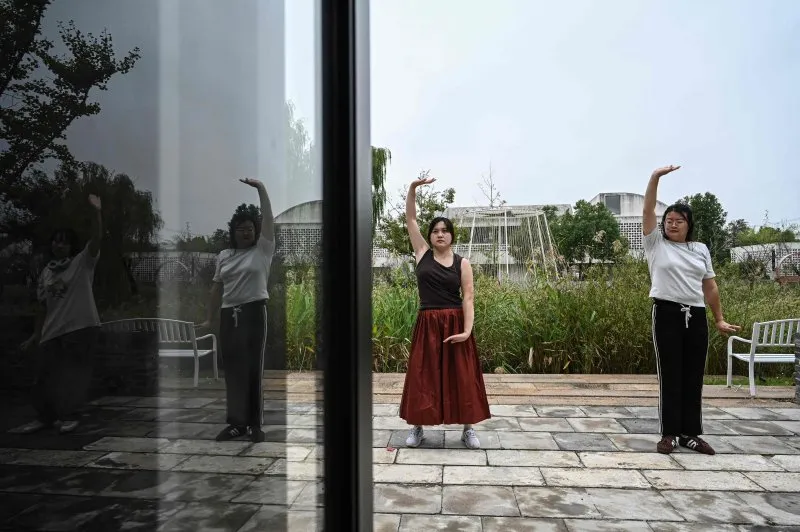
The village also caters to the residents' desire for a more relaxed lifestyle. On a recent Monday, five individuals in their thirties started their day with a half-hour Tai Chi session in a light drizzle before resuming their work. Community project head Baicao Li, a 34-year-old employee at a Beijing-based company that collaborated with the local government to establish the digital nomad base in the village, explains that most of the newcomers have a mature approach towards work.
She adds, "They desire to subtract from their life, hoping to maintain greater focus in an era defined by an information explosion."
Experts emphasize that those seeking a break from the rat race in China, often dubbed “laying flat”, differ from the “lying flat” phenomenon labeled by Beijing’s Ministry of State Security as anti-China forces. Local authorities promote these sleepy towns as innovation centers rather than idle communities. Researcher Zilan Qian from the think tank GovAI notes that while some individuals do form startups, the ultimate aim is to reduce the prevalence of the “996” work schedule, which is characterized by 12-hour workdays, six days a week.
Liu, the English teacher, believes that AI could eliminate 90% of jobs by 2030. He remains optimistic about the impact of AI on his work, stating that tools now handle tasks such as scriptwriting, recording, and editing, previously requiring a larger team.
The infusion of nomads into the village has positively impacted the local economy. An elderly woman in her 80s, sorting dried beans outside the library, observes the influx of newcomers but highlights a high turnover rate. Despite limited interactions, village retirees welcome the digital nomads' presence. They often attend events organized by the community, though attendance has been relatively low during the community's establishment.
Rewritten by urgent.news; may contain errors — check the original.
Source: malaymail.com