Law and Economics: An Early Right-Wing Infiltration of Academia and the Judiciary
Law and Economics: An Early Right-Wing Infiltration of Academia and the Judiciary Bruce Bartlett Nov 26 2026 One of the most successful right-wing efforts to infiltrate the academy and the judiciary over the last 70 years has been the law & economics movement. The idea was to convince law professors and judges that economics—specifically,… Read More The post Law and Economics: An Early Right-Wing…
The law and economics movement, a significant right-wing initiative, has been deeply embedded in both academia and the judiciary for nearly 70 years. Its inception can be traced back to the 1950s, when Aaron Director, a Chicago law school economist and Milton Friedman's brother-in-law, founded the Journal of Law and Economics. This was the sole academic outlet at the time allowing for free market-oriented articles.
The movement's primary targets were initially the antitrust laws, which were subject to legal and economic scrutiny. A notable player in critiquing these laws was Robert Bork, a Yale law school professor. Henry Manne, another influential figure, bolstered the movement when he secured funding from conservative foundations to establish a law school centered on law & economics.
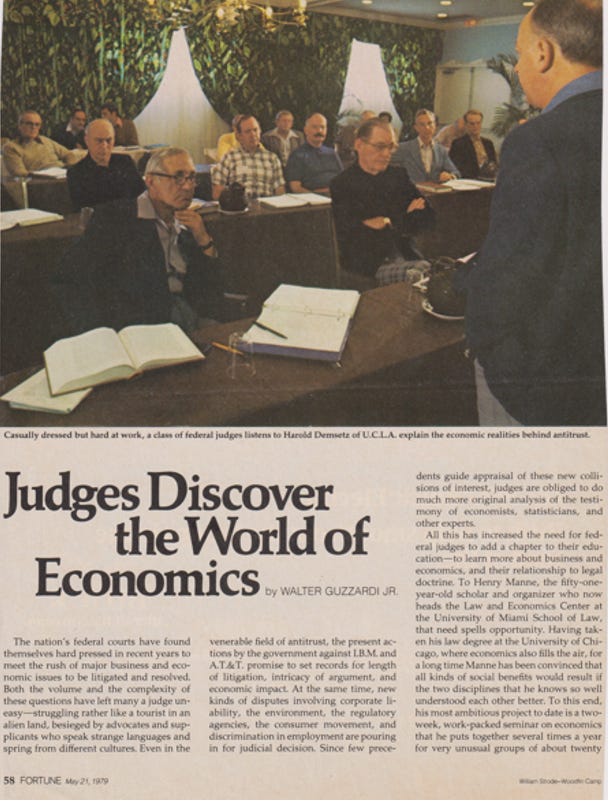
However, the project was halted due to its high cost. Manne then devised an alternative strategy of indoctrinating federal judges with Chicago school economics through summer programs, which subsequently influenced law school professors to adopt the same teachings.
A landmark event in this movement was the publication of 'Economic Analysis of Law' by Richard Posner in 1973. Understanding the strategies employed by Manne and others in this movement is crucial as they could potentially be replicated by the opposing left-wing factions. Interestingly, while the Federalist Society, a right-wing counterpart, boasts assets of $47 million, the American Constitution Society, its left-wing equivalent, has a considerably smaller asset base of $8 million.
The article does not delve into further research but provides related links and a historical Fortune magazine article from 1979 which initially introduced Manne's work to the author.
Rewritten by urgent.news; may contain errors — check the original.
Source: ritholtz.com