Digital Hoarding: Why Are We Saving Everything On Our Phones But Never Going Back To It?
Take a moment to scroll through your phone’s gallery. There are probably screenshots of restaurant recommendations, outfits you spotted online, recipes you promised to try and videos you thought were worth watching later. Then there are the unread emails and browser tabs that have somehow survived for weeks. Sounds familiar? We are constantly surrounded by information, and somewhere along the…
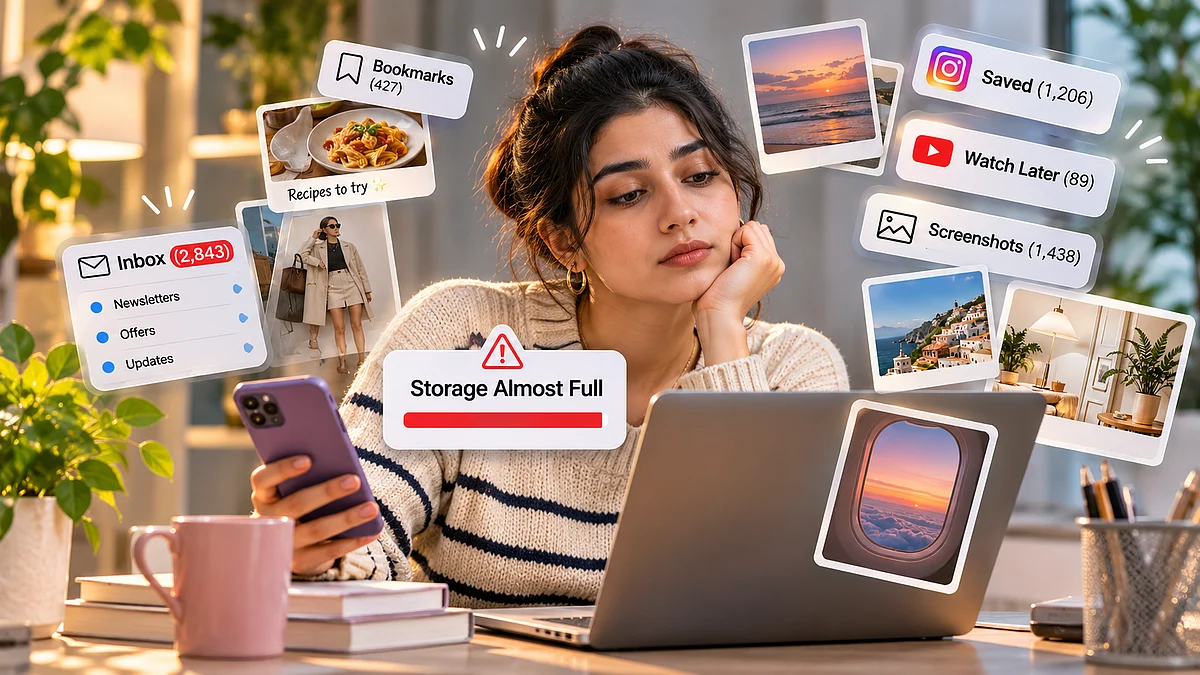
Glancing at the contents of your phone's photo library, you'll likely find a mix of screenshots, potential meal ideas, and videos you intend to watch later. Alongside these are unread messages and browser tabs that have somehow persisted for weeks. This is a common experience in our information-rich world, where we tend to save everything we encounter. But when did our devices transform into repositories of seldom-used digital content? Welcome to the era of digital hoarding.
Digital hoarding involves the excessive accumulation of digital content, often without a clear reason for preservation. Unlike physical clutter, digital items can pile up across phones, laptops, cloud storage, and social media platforms. This can include duplicate photos, downloaded files, old documents, newsletters, and countless bookmarked posts. The buildup often goes unnoticed until a notification pops up indicating that storage is nearly full.
The allure of digital hoarding lies in the belief that some information might prove useful in the future. We save makeup tutorials, restaurant recommendations, or workout routines, convinced that we'll put them to use someday. This mindset provides a false sense of security, as deleting content can feel akin to discarding potential options. In reality, saving is often driven by the desire to maintain possibilities, even if we never actually act on them.
Social media platforms have made the act of saving content effortless. Instagram's saved collections, Pinterest boards, YouTube's watch-later feature, and online shopping wishlists allow users to organize everything that catches their eye. For many, these collections have become personal mood boards, housing fashion inspiration, wedding references, travel dreams, home decor ideas, beauty trends, and career aspirations.
However, for some, saved content transcends mere inspiration and becomes a means of preserving memories and connections. Creator Amaan Nagan notes, "As an individual and creator, I find myself revisiting saved Instagram reels, screenshots, and posts, as well as saved DMs from people I care about or am attracted to. Saved reels help with ideation and inspiration, while some reels are useful, while others collect dust.
Saved chats give me hope in initiating conversations with someone I desire a genuine connection with."
Yet, the ease of saving also leads to an endless stream of digital clutter. A post saved today can quickly become buried beneath more recent additions. Ironically, while we've made it simple to save information, making it easy to find or utilize it remains a challenge. This raises the question: why is it so hard to let go? Some saved content holds emotional value.
An old photograph might evoke memories of a specific vacation, a chat could bring back familiar feelings, and an old video could encapsulate a moment we're not yet ready to let go of. Even insignificant files may carry sentimental worth. Additionally, the discomfort of decision-making can be a factor. Should we delete that photo?
What if we need that document later? What if the post is lost forever? Gradually, clinging to these items often feels less daunting than deciding what can be discarded.
The inconvenience becomes apparent when searching for important information takes longer than anticipated. An overcrowded digital space can also foster a sense of unfinished business. Those unread articles, saved recipes, and bookmarked videos serve as constant reminders of tasks we intended to complete but never did. Psychologist Dr. Hozefa A. Bhinderwala from Saifee Hospital, Mumbai, explains, "Humans, as a species, have evolved over millennia, experiencing times of abundance and scarcity.
Although we rarely face food or water shortages today, we still exhibit a mindset of being prepared for sudden scarcity. In the digital age, digital hoarding serves as a coping mechanism driven by three factors: Fear of Missing Out (FOMO) and loss aversion, attachment and identity, and offloading. Deleting files can trigger anxiety about potential loss of ideas, opportunities, or future help, which makes people uncomfortable.
Holding onto files provides a sense of control over the vast amount of information surrounding us. Digital files, being part of our memories and self-perception, can be difficult to part with. Offloading, or saving links, mimics having an external drive, allowing our brains to offload information temporarily, alleviating the burden of immediate processing."
Rewritten by urgent.news; may contain errors — check the original.
Source: freepressjournal.in