Did You Know Darkness Is Utah’s Biggest Attraction? Explore Its Magical Night Skies
The sun has set behind the towering sandstone cliffs hours ago, but our guide insists the day isn’t over yet. Driving into the wilderness when barely anything is visible to the naked eye seems an odd proposition. “What you can’t see in the big cities, you can see here,” he says. When we signed up for a road trip across Utah’s rust-red, cinematic landscapes, escaping insufferable AQI levels was…
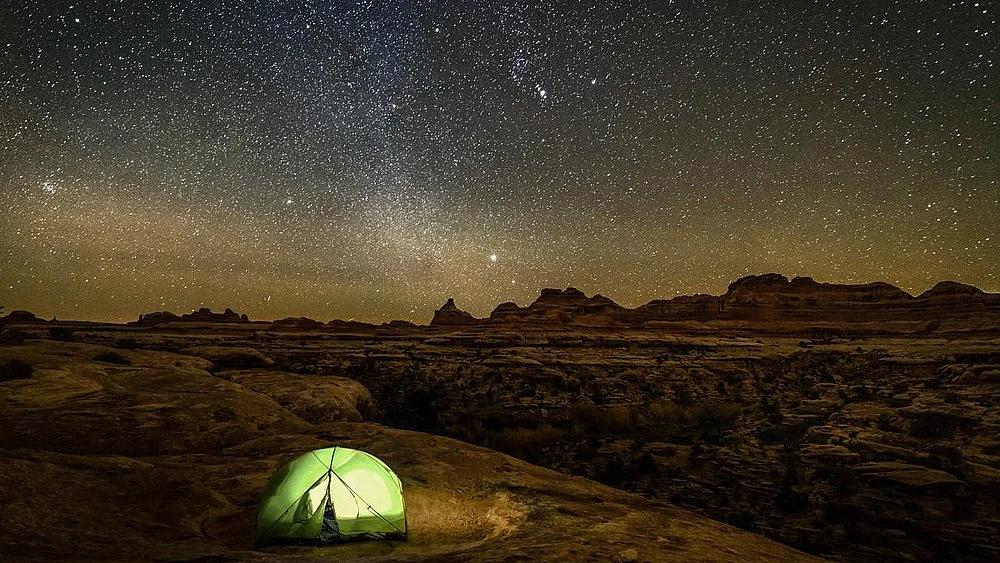
After the sun has dipped below the towering sandstone cliffs, the guide reassures travelers that the day is not yet over. In Utah's stark and cinematic landscapes, escaping the smoggy air is just the beginning. Perched on a rocky ledge, we find ourselves in the depths of a pitch-black sky, speckled with a few twinkling stars. It is a humbling experience that underscores our existence's origins.
Psychology studies reveal that such awe-inspiring encounters make us less self-centered and more empathetic towards others. Stargazing, in our fast-paced lives, becomes especially relevant, as even our worries appear less daunting under an infinite sky.
However, the night sky is under threat. Over a third of humanity cannot see the Milky Way from their homes, and night skies are becoming progressively brighter due to light pollution. Utah has been at the forefront of the global movement against light pollution. In 2007, Natural Bridges National Monument became the world's first International Dark Sky Park.
Today, Utah boasts one of the highest concentrations of internationally certified dark-sky destinations, including all five of its national parks and Antelope Island State Park.
The challenge of preserving these dark skies is real. The small town of Torrey became Utah's first International Dark Sky Community in 2018, with locals crowdfunding the installation of downward-facing streetlights to minimize skyward scattering. Bluff, a town with only 240 residents, has been hosting annual star parties since 2016, featuring telescope viewings, conservation talks, and storytelling from Indigenous traditions.
These initiatives, coupled with lighting regulations and ordinances, have earned Bluff its community certification in 2025.
Utah's national parks offer a different world after sunset. Capitol Reef National Park is famously open to night visitors, with an abundance of nocturnal creatures such as kangaroo rats, ringtails, owls, and bats. Artificial lights, however, can disrupt their feeding patterns, expose them to predators, disorient migratory birds, and interfere with the behavior of nocturnal insects.
Utah's protected wilderness areas thus require monitoring sky brightness, managing illumination levels, and educating visitors about the importance of natural darkness.
All Utah's national parks remain accessible to visitors at night, although certain rules apply. At Arches National Park, even photographing the arches for artistic purposes is prohibited to preserve the natural night view. It takes our eyes roughly half an hour to fully adjust to the darkness, after which the stars become abundantly visible. Even a small torch or camera flash can significantly disrupt this adjustment process.
The US National Park Service formally recognizes natural darkness as a valuable resource, comparable to forests, wildlife, and geological formations. A burgeoning astrotourism industry has emerged around this protected resource, with stargazing excursions, astronomy festivals, and accommodations catering to skywatchers creating new economic opportunities for rural communities. A 2019 study projected that dark-sky tourism could generate approximately USD 5.8 billion in spending across the Colorado Plateau over a decade.
The idea of preserving natural darkness while generating sustainable income challenges our Western notion of progress. In India, dark skies are abundant but threatened by growing affluence. Conservation efforts are gaining momentum, from India's first Dark Sky Reserve in Ladakh to Dark Sky Parks in Pench Tiger Reserve and Kolli Hills. As urban dwellers, we can appreciate the humble pleasure of gazing up at the night sky, a simple yet deeply enriching experience that renews our connection with the natural world.
Rewritten by urgent.news; may contain errors — check the original.
Source: freepressjournal.in