El ‘problema del pavo’ de Wall Street: ¿Por qué es un riesgo apostar demasiado al auge de la IA?
La actual incertidumbre en Wall Street recuerda al llamado 'problema del pavo'., una parábola popularizada por Nassim Nicholas Taleb.
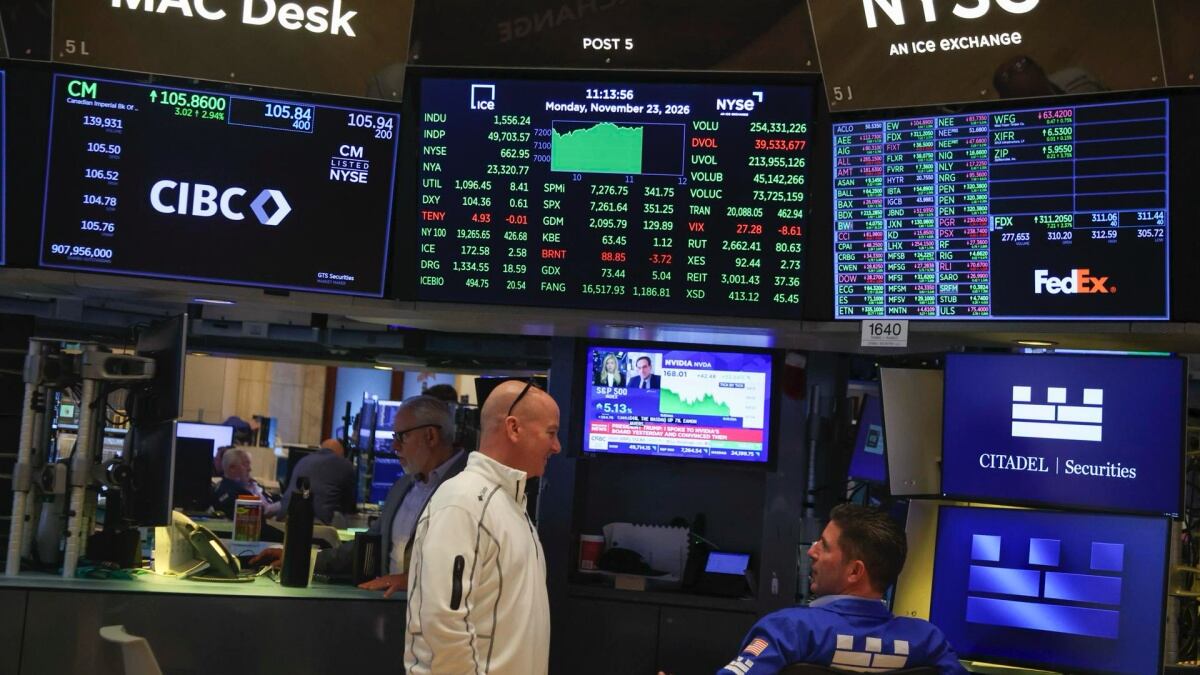
The ongoing uncertainty on Wall Street echoes the so-called "turkey problem," a popular parable attributed to Nassim Nicholas Taleb that Bloomberg recently resurrected to warn against relying on the rapid rise of artificial intelligence (AI) to continue propelling markets. In Taleb's example, a turkey accumulates for a thousand days proof that the farmer feeding it is trustworthy, until Thanksgiving arrives and the turkey discovers the trust was unjustified.
Taleb used this parable in his 2007 book 'The Black Swan' to explain how a long sequence of favorable experiences can create a false sense of security, overlooking unexpected events. Could AI be the next "black swan"? The comparison rings true at a time when investors have questioned whether the huge amounts poured into AI will deliver the expected benefits and whether the tech giants can maintain the momentum that has buoyed the stock market and the U.S. economy.
On Friday, Wall Street closed with a weekly gain of 5 percent, while the tech Nasdaq rose 6 percent, despite sharp falls throughout the week. In November, several companies linked to AI development suffered heavy losses in the stock market. Nvidia, embroiled in the scandal surrounding its co-founder, Jensen Huang, fell nearly 24 percent, while semiconductor manufacturers AMD and Broadcom experienced declines of around 14 percent.
Among the big techs, Alphabet and Meta lost about 13 percent and 8 percent, respectively. The moment also affected Anthropic, the creator of the chatbot Claude, whose stock fell below its IPO price just days after its debut on the Nasdaq. According to a Wall Street Journal (WSJ) analysis published this week, investments related to AI accounted for about a quarter of U.S. economic growth over the past year.
The newspaper warns that a slowdown in that spending could affect both stocks and consumer spending, the main driver of the U.S. economy given the weight that stocks have acquired in household wealth. Doubts extend beyond stock prices: the surge in AI has also driven the construction of data centers and the activity of construction companies and equipment manufacturers, but financing some of those projects raises questions.
"Some of them rely on complex debt structures and non-bank loans, whose connections are not fully known," warns the economist Jeremy Stein. Meanwhile, Goldman Sachs analyst Vincent Lin explains in a report that large investment funds are "diversifying risks and adopting a more prudent attitude" following weeks of volatility. "Investors are showing greater interest in sectors considered safer, such as healthcare, utilities, and consumer staples," he notes.
This uncertainty also adds to monetary policy, especially if the Federal Reserve does not cut interest rates in December to combat inflation, which would increase financing costs and may weigh on company valuations, particularly those that require large investments like those in AI. Despite all this uncertainty, Goldman Sachs predicts that S&P 500 earnings growth will moderate to 11 percent in 2027, down from the nearly 30 percent they estimated for this year.
The firm adds that the AI investment push may "lose strength" as the market needs to find "new sources of growth." As in Taleb's parable, "the hand that feeds you may also be the one that bites your neck," and the risk is that investors interpret the long run of gains as proof that nothing can go wrong, when the same environment that fueled the AI surge could "change in any moment," Bloomberg warns.
Rewritten by urgent.news; may contain errors — check the original.
Source: elfinanciero.com.mx