Caveman repurposes old mining rig for local AI, pools 72GB VRAM across mismatched GPUs
Caveman employs mining rig for local AI, finds a PCIe x1 slot is more than enough — link only 10% busy even when using multiple cards
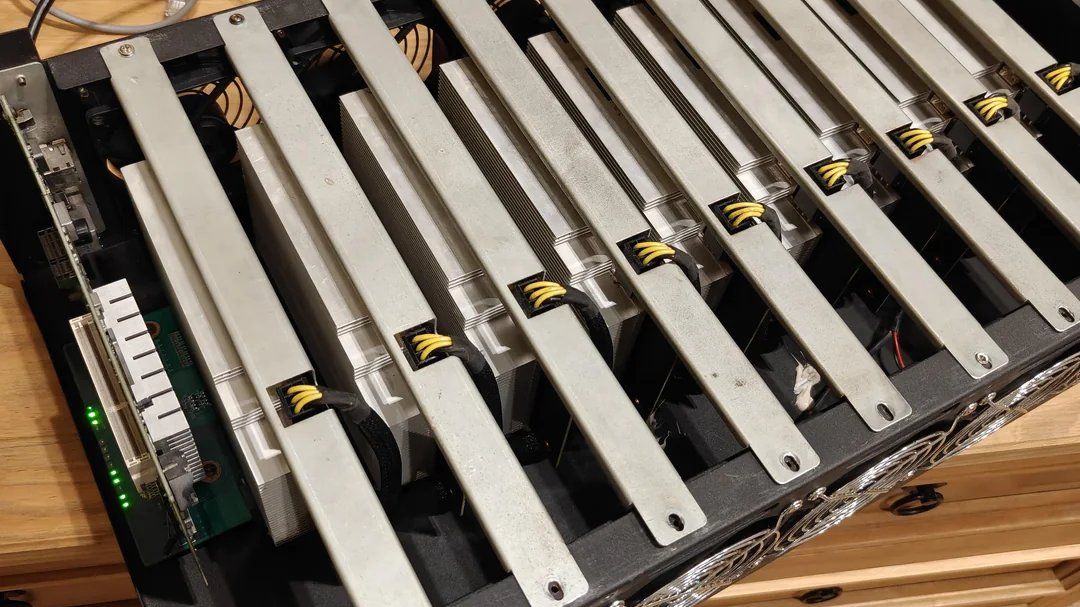
Caveman Tech managed to repurpose an old mining rig outfitted with mismatched GPUs for AI computations. They utilized a PCIe x1 slot, which initially seemed insufficient for larger models. However, the result proved surprisingly effective.
By running a Quadro RTX 4000 on the PCIe x1 slot, they achieved similar token generation speeds to using a card in a standard x16 connector. The only drawback was a longer model load time, which was acceptable for individual models. With further tweaks, they achieved a token generation speed of 96 tokens per second on the x1 slot, defying the assumption that low-bandwidth slots are not useful for AI work.
Next, they experimented with a staggeringly asymmetric configuration using a CMP 170HX with 64GB of VRAM on the primary PCIe x16 slot, alongside the Quadro 4000 (8GB) on the x1 slot. In this setup, layer splitting resulted in only 10% usage of the PCIe x1 link, as cards primarily transmitted calculation results rather than model weights. This configuration maintained a token generation speed of 91 tokens per second, compared to 52 tokens per second when using system RAM.
Finally, they tested a configuration with tensor mode, where all cards handled portions of all layers, but found that prompt reading dropped significantly. However, they discovered that using a second card on the x1 slot still outperformed spilling to CPU RAM by 1.8 times. These results demonstrate that judicious configuration can effectively expand available VRAM, allowing for the use of larger, more advanced AI models on systems with limited bandwidth slots.
Rewritten by urgent.news; may contain errors — check the original.
Sources: dev.to · tomshardware.com