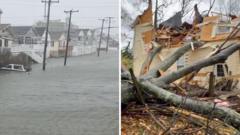
Q&A: What matters most to homeowners facing flooding?
The annual amount of precipitation and the frequency of extreme events have increased in Pennsylvania in recent decades, and both are expected to continue increasing, leading to a higher flood risk. Most climate risk studies, however, reflect a limited understanding of how people interpret and act on flood risk. To develop a stronger culture of proactive disaster preparedness, that needs to…

As climate change and land-use decisions intensify flood risk, homeowners in flood-prone areas like the Central Susquehanna River Valley face a growing challenge. Casey Helgeson, an associate research professor at Penn State, emphasizes the importance of understanding homeowners' values in flood planning. In a recent case study, researchers explored the diverse ways flooding and adaptation actions impact residents, uncovering a wide range of values that shape decisions and priorities.
Helgeson highlights that many climate risk studies focus solely on economic impacts, such as property damage and insurance costs, while neglecting other crucial aspects like insurance rates, property values, personal safety, and the desire to maintain control over one's home. This limited perspective fails to capture the full extent of how flooding affects homeowners' lives.
To address this gap, the researchers developed a conceptual model using boxes and arrows to represent actions and variables in the system, as well as the causal relationships between them. This mental model helps illustrate how flooding impacts people's lives in a local context. The study identified seven distinct value categories, including finance, personal safety, place attachment, personal autonomy, time and effort, and the impact of adaptation strategies on property values.
Homeowners' values are shaped by individual experiences and social connections, influencing how they interpret hazards and evaluate the feasibility of adaptation strategies. For instance, some homeowners prioritize financial stability, while others place a higher value on preserving their connection to a particular place or maintaining control over decision-making processes.
The researchers found that homeowners employ various strategies in response to flooding, such as elevating homes, installing floodproofing measures, obtaining insurance policies, or relocating to less flood-prone areas. Surprisingly, one common practice they didn't anticipate was the use of savings accounts as a form of self-insurance.
By mapping homeowners' values onto the conceptual models, the researchers created a blueprint for impact studies that consider stakeholders' priorities. This approach can improve future analysis of household-level adaptation actions, like home elevation, which are often funded at the state or federal level. Ultimately, the study aims to expand the scope of impact measures in adaptation studies and investigate other climate risks, while also highlighting the limitations of narrow effectiveness criteria.
Rewritten by urgent.news; may contain errors — check the original.
Source: phys.org