The single-photon challenge: an integrated approach to verifying quantum emitters
Bringing spatial localisation and photon antibunching measurements into a single experimental workflow is accelerating the characterisation of new materials for quantum technologies The post The single-photon challenge: an integrated approach to verifying quantum emitters appeared first on Physics World .
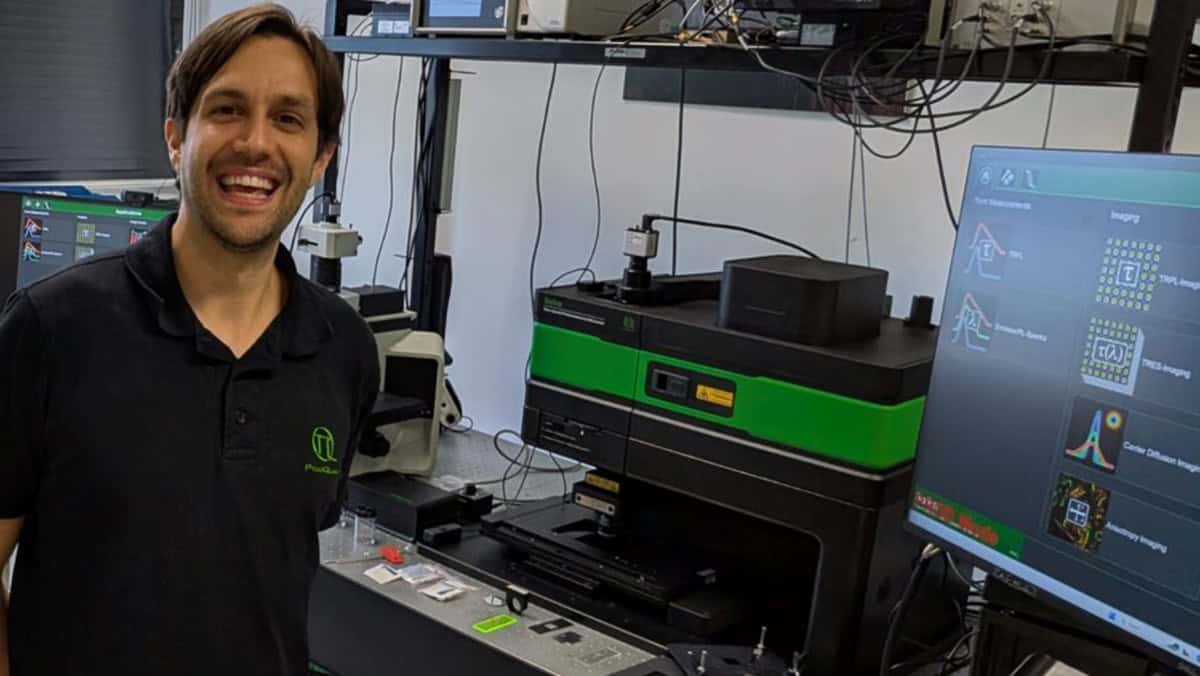
Emilio Guiterrez-Partida, Product Manager at German photonics instrumentation company PicoQuant, highlights the potential of solid-state quantum emitters for various quantum technologies. Solid-state quantum emitters, such as quantum dots, wires, and defects, can emit single photons or entangled photon pairs through well-defined energy transitions. However, these emitters face the challenge of consistently producing pure and stable quantum light, which is crucial for their application in real devices.
To address this challenge, PicoQuant's Solira system combines spatially resolved photoluminescence imaging with photon-correlation measurements. The system identifies nanoscale quantum emitters in a sample, such as nitrogen-vacancy centres in diamond, and assesses their single-photon emission characteristics. These nitrogen-vacancy centres act as single-photon emitters due to their altered electronic structure caused by the presence of a nitrogen atom and a missing carbon atom.
Their room temperature operation and stable diamond host lattice make them predictable and robust emitters, making them suitable for practical quantum technologies.
PicoQuant recently used Solira to demonstrate this workflow with diamond nitrogen-vacancy centres in various nanodiamond samples. The researchers first assessed the samples using time-resolved photoluminescence imaging to identify spatially isolated emission spots and select candidate emitters. They then performed second-order photon correlation measurements to look for photon antibunching, a quantum characteristic indicating that the emission originates from a single emitter.
The measured g(2)(0) values of approximately 0.4 and 0.21 for selected spots in commercial and lab-prepared samples, respectively, confirmed pronounced antibunching and demonstrated the successful identification of single-emitter quantum light.
Rewritten by urgent.news; may contain errors — check the original.
Source: physicsworld.com