Modelling quantum criticality with black holes
Holographic duality model reveals a new form of quantum critical behaviour The post Modelling quantum criticality with black holes appeared first on Physics World .
Quantum critical points represent a transition between different states of matter, occurring at absolute zero temperature. Unlike conventional phase transitions, these are driven by non-thermal parameters like magnetic fields, pressure, and chemical potential. At these critical points, strong quantum fluctuations occur, affecting the system over extensive distances.
This leads to descriptions based on quasiparticles often becoming inadequate. Quantum criticality is of great interest due to its exotic behavior and strong quantum fluctuations, and its potential to solve key problems in condensed matter physics, such as Kondo breakdown, strange metals, unconventional superconductors, and other strongly correlated electron systems.
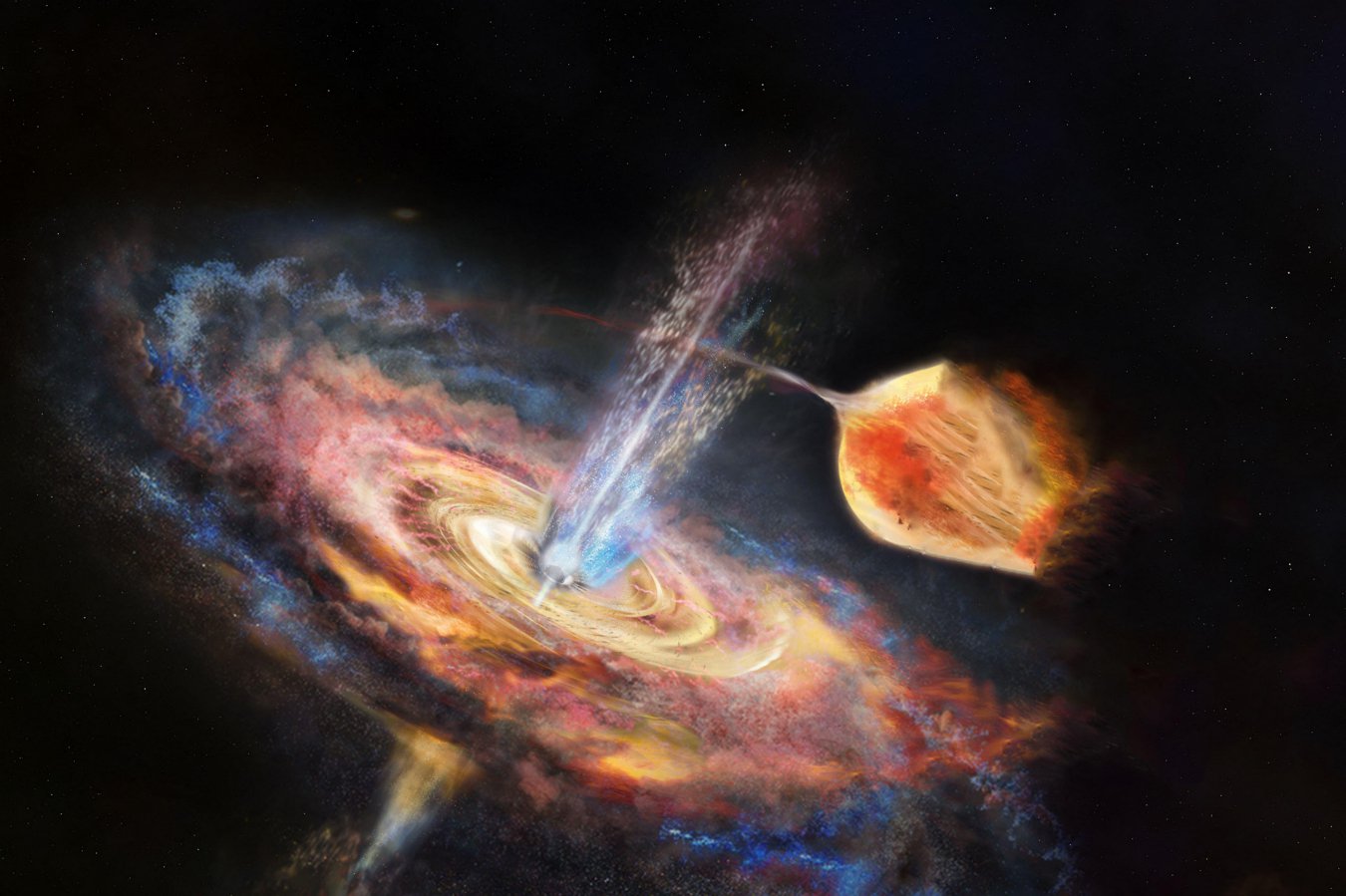
Conventional descriptions struggle because every particle interacts strongly with many others. However, holographic duality offers an alternative mathematical approach to understanding the same physics. In one perspective, the system consists of interacting electrons displaying complex quantum behavior. In the other, it's represented by a higher-dimensional gravitational system containing a black hole.
Despite their apparent dissimilarity, holographic duality implies these descriptions can capture the same universal behavior.
In their study, researchers utilized a black-hole-inspired holographic model to explore quantum criticality driven by a magnetic field. They discovered a novel type of quantum critical behavior and discovered that the magnetic Grüneisen ratio, indicating the relative temperature response to magnetic field changes at a fixed entropy level, diverges with universal scaling near the quantum critical point. This predicted scaling behavior aligns with recent experiments conducted on a heavy-fermion material.
The significance of this research lies in identifying a potentially new universality class that could shed light on puzzling observations in quantum critical materials. Additionally, it showcases the practical application of holographic duality in studying complex quantum many-body systems. The full article, titled "Universally diverging Grüneisen ratio of holographic quantum criticality," was authored by Jun-Kun Zhao et al. and published in "Reports on Progress in Physics" in 2026.
For those interested in delving deeper into this topic, one can refer to "Frustration and Quantum Criticality" by Matthias Vojta (2018).
Rewritten by urgent.news; may contain errors — check the original.
Source: physicsworld.com