Comet Encke's Shape and Heat Revealed in Thermal Glow
Comets are time capsules of the origins of the solar system, containing materials that have existed for billions of years. While comets primarily orbit in the farthest reaches of the solar system, specifically the Kuiper Belt or Oort Cloud, some make their way closer to the Sun. When this happens, the increased heat cause cometary icy material to evaporate, producing a spectacular tail while also…
Comets serve as time capsules, preserving materials from the early solar system. Occasionally, comets approach the Sun, causing their icy components to vaporize and form a tail, while also unveiling the underlying rocky nucleus. Researchers from Japan have taken a step closer to understanding cometary nuclei' composition and temperatures through recent findings published in The Astronomical Journal.
By analyzing archived data of Comet 2P/Encke, obtained in November 2003 using the Cooled Mid-Infrared Camera and Spectrometer (COMICS) on the Subaru Telescope, the team revealed new insights into the shape and temperature of the comet's nucleus. This information could aid in understanding both the formation and evolution of comets and the solar system.
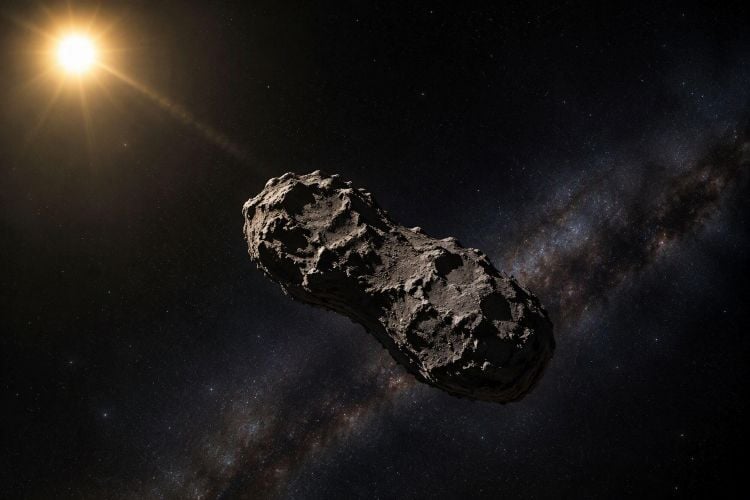
Comet 2P/Encke measures approximately 7 kilometers by 3 kilometers (4.3 miles by 1.9 miles), with its surface temperature estimated at 328 Kelvin (55 degrees Celsius/131 degrees Fahrenheit). Dr. Takafumi Ootsubo, the lead author of the study, emphasized the significance of mid-infrared observations in directly capturing thermal emission from the nucleus.
Despite COMICS retiring in 2020, Dr. Ootsubo aims to restart the program to study more cometary nuclei in detail. Comet 2P/Encke, originating from the Kuiper Belt, followed by Jupiter's gravity, now has a 3.3-year orbit. Although it doesn't encounter Earth every 3.3 years, it has had limited close encounters in recent decades, with the next predicted approach in February 2027.
The study's findings could lead to a deeper understanding of comets and their role in the solar system in the years and decades to come.
Rewritten by urgent.news; may contain errors — check the original.
Source: universetoday.com