Earth’s Water May Have Formed in This Fiery Furnace
No ice deliveries needed The post Earth’s Water May Have Formed in This Fiery Furnace appeared first on Nautilus .
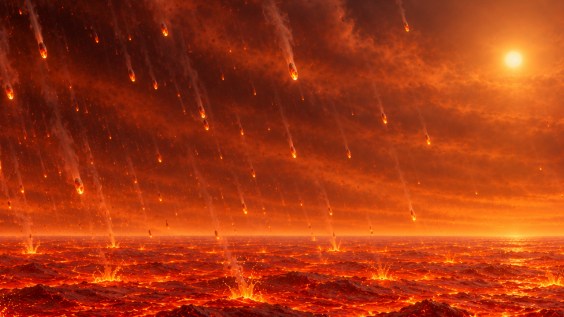
The origin of water on Earth has long been a fundamental question in understanding the development of life on our planet. A new study published in Nature Geoscience proposes a novel explanation for this mystery, suggesting that water may have formed through a process called "pebble rain" or "pebble accretion." This theory challenges the previous notion that water was delivered to Earth by meteorites or comets from outer space.
According to the researchers behind the study, the process begins with silicate rocks containing iron, which are drawn towards Earth due to its increasing mass and gravitational pull. As these rocks enter Earth's atmosphere at high speeds, pressures, and volumes, they react with hydrogen in the atmosphere. This chemical reaction leads to the stripping away of oxygen from the iron present in the rocks, resulting in the release of water vapor as a by-product.
The researchers estimate that approximately 200 oceans' worth of H2O could have been generated through this process, providing the essential ingredient for life on Earth. Unlike meteorites, the water formed through this method originated on Earth itself, rather than being delivered from space. Furthermore, the same mechanism could potentially occur on other planets as they form, expanding our search for extraterrestrial life.
Zachary Sharp, the lead author of the study, explains that current theories regarding the source of water on Earth rely on external sources, such as comets or meteorites. However, the newly identified pebble rain mechanism suggests that virtually any Earth-sized planet should have water formed through this process. The researchers tested their hypothesis in the lab, simulating early Earth conditions with temperatures up to 2,552°F and heating silicate rocks in streams of hydrogen.
Their results showed that nearly 80% of the iron oxide in the samples transformed into metallic iron, producing water vapor in the process.
The discovery of this paradoxical desert landscape filled with fresh water serves as a reminder that even in seemingly inhospitable environments, life-giving water can be produced. As Sharp poignantly states, "Looking out over a large body of water, it’s hard to imagine that that water may have been produced four-and-a-half billion years ago in a hell-like atmosphere, but it very well may have."
Rewritten by urgent.news; may contain errors — check the original.
Source: nautil.us