Kraftstoff: Preisdeckel könnte Sprit 7,5 Cent pro Liter vergünstigen – Höchstpreise würden fast jeden Tag greifen
Handelsblatt-Berechnungen zum neuen Spritpreisdeckel-Vorschlag von Wirtschaftsministerin Reiche zeigen: Der Höchstpreis würde regelmäßig greifen – vor allem um eine bestimmte Uhrzeit.
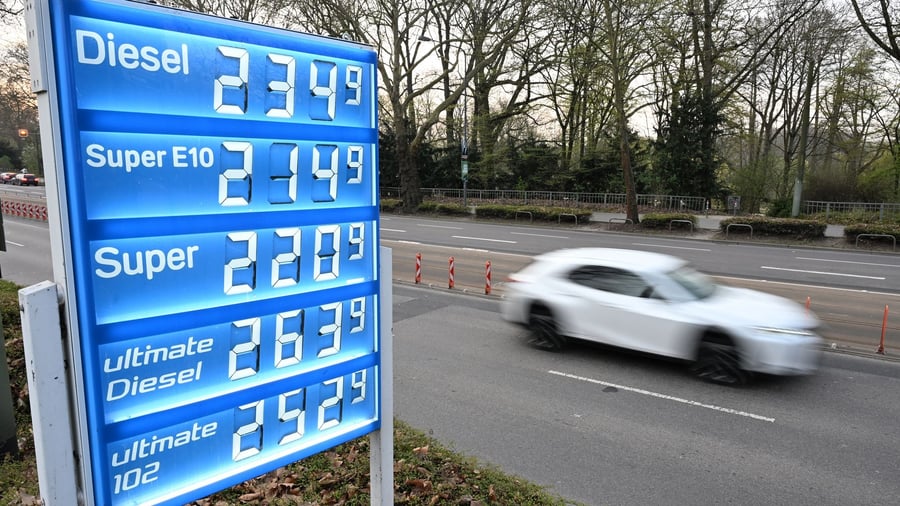
The proposed fuel price ceiling by the German federal government could frequently result in cheaper fuel prices at German gas stations starting from next year, according to calculations by the Handelsblatt based on a new draft law from the Ministry of Economics. The draft law, currently being internally approved within the government, has been reported exclusively by the Handelsblatt on Friday.
The fuel price ceiling could thus almost daily cause lower prices for both gasoline and diesel, averaging five to 7.5 cents per liter cheaper over the course of eleven to fourteen percent of the time compared to without the state intervention. The average price reduction would be roughly five to 7.5 cents per liter. The government has been in dispute over the first introduction of a fuel price ceiling since weeks.
In September, the federal government and the states agreed on the measure to take effect from January 1st, following the high fuel prices due to the Iran war. Reiche presented a first draft law in early November, which, however, only provided for a check in January whether the introduction of a price ceiling would be necessary instead of introducing it immediately.
This led to massive protests from the SPD. On Tuesday at the coalition committee, the top representatives of the CDU, CSU, and SPD agreed that the ceiling would become effective from January 1st. Reiche then worked on the new draft law, adding new restrictions. The minister worries that a too strict price ceiling could trigger fuel supply bottlenecks.
The formula for calculating the maximum price now includes fuel wholesale prices, which orientate themselves to the most expensive region in Germany. The margin for the gas stations is also included in the calculation, so that only ten percent of the gas stations have a higher margin without the price ceiling. The determination will be made using historical data.
The possible effect can therefore be assessed by calculating how the fuel price ceiling would have affected prices in recent history. In 2025, without the fuel price ceiling, fuel prices would have been about 13 percent of the time above the ceiling, and the ceiling would have led to an average price reduction of around five cents per liter in such cases.
On 296 days of the year, the price ceiling would have lowered the prices by at least once. Between January and March 2026, fuel prices were also about 13 percent of the time above the ceiling, and the ceiling would have lowered the prices by an average of five cents per liter 64 times. These overshoots mainly occurred early in the morning around 7 AM, with almost all gas stations above the ceiling.
In the evenings, hardly any. Since April 2026, the legislator decided that gas stations may only raise their prices once a day, at 12 PM. From then on, the ceiling would have had a stronger effect if it had been in place: In this period, prices were only above the ceiling eleven percent of the time, and when they were, the average price increase was seven cents per liter.
The intervention in the pricing mechanism would be the rule. Overall, this is a significant tightening compared to Reiche's original draft law. In this draft, the price ceiling would only have been triggered when fuel prices in Germany had significantly deviated from those in the rest of Europe. Calculations showed that such a situation would have hardly ever occurred in recent years.
Service stations were excluded from the effect of the new model, as they were excluded from the draft law. The reason: These significantly more expensive providers would otherwise push the maximum price upwards during the calculation. The argument is that if this were included, a significant price reduction would be expected at these service stations.
Calculations show that prices at service stations in recent history were above the ceiling around 85 percent of the time, with an average increase of about 37 cents per liter.
Rewritten by urgent.news; may contain errors — check the original.
Source: handelsblatt.com