Gezegen ararken gizli bir yıldız buldular: 28 ışık yılı uzaktaki sistem şaşırttı
Bir yıldızın hareketini yaklaşık beş yıl izleyen gökbilimciler, yakınında saklanan bir beyaz cüceyi ortaya çıkardı. Dünya’dan yaklaşık 28 ışık yılı uzaktaki sistemin üç yıldızdan oluştuğu belirlendi. Ancak bu üçlünün bugünkü düzenine nasıl ulaştığı henüz açıklanamıyor.
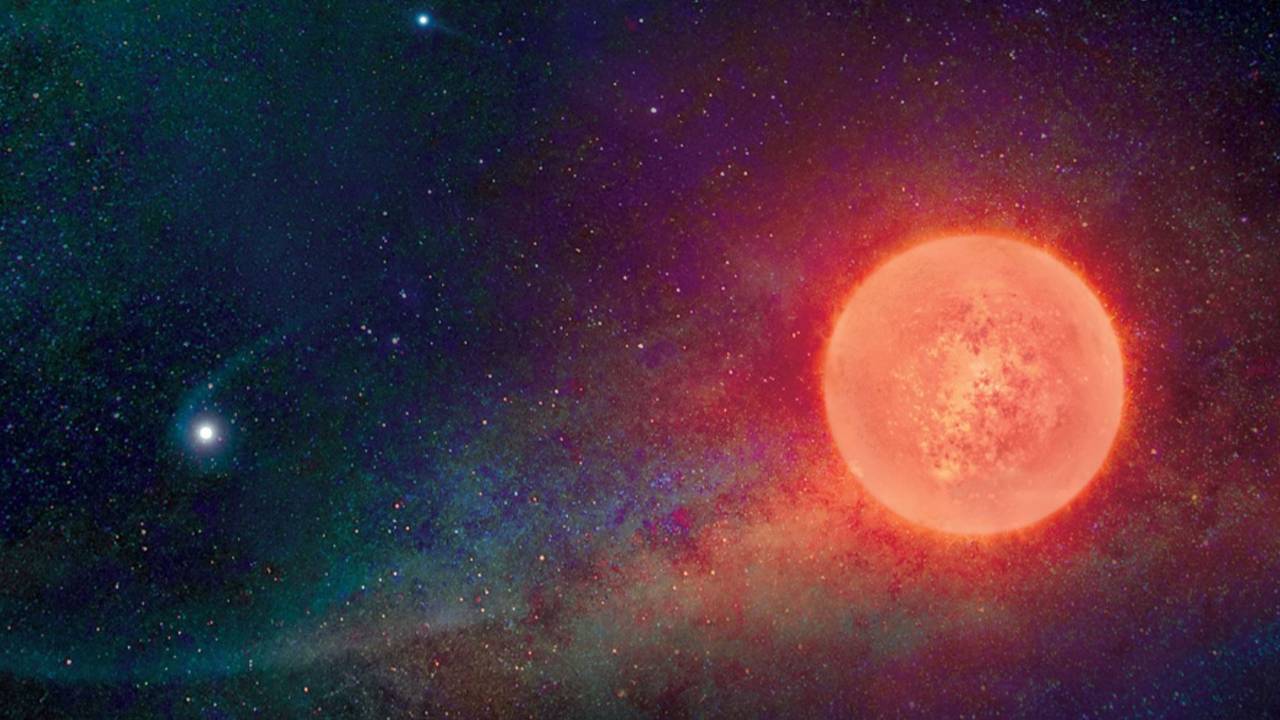
Astronomers discovered an unexpected find while searching for exoplanets around a red dwarf star named Welopōʻai. The star's unusual changes in movement revealed the presence of a previously unseen white dwarf nearby. The team led by Étienne Artigau from the Trottier Exoplanet Research Institute at the Montreal University conducted this research, which was published in the Astronomy & Astrophysics journal on November 19.
Welopōʻai consists of one red dwarf and two white dwarfs. The white dwarfs are the remnants of stars that shed their outer layers at the end of their lives, similar to what happens to sun-like stars. The initial clue for this discovery came from the SPIRou device on the Canada-France-Hawaii Telescope in Hawaii. Scientists measured the star's approach and retreat using this method, which detects the tiny movements caused by a planet orbiting the star.
However, the variations in the star's highest and lowest visibility speeds, up to 16 kilometers per second over a period of 4.8 years, could not be explained by the planet's influence alone. To determine the unseen companion's identity, the team turned to the Gemini North telescope. High-resolution images and close-in infrared observations confirmed that the unseen companion is a white dwarf near the red dwarf.
They also knew about another white dwarf located further away in the system. Thus, Welopōʻai is now known to be the closest known triple star system, containing two white dwarfs. The researchers now aim to understand the star's history. It is believed that the newly identified white dwarf once expanded into a red giant star before becoming a white dwarf.
This expansion would have taken place in close proximity to the nearby red dwarf, likely interacting with it strongly. Such processes could result in two stars getting much closer in their orbits, potentially even merging. In Welopōʻai, the red dwarf remains, and the system is in a binary configuration that is likely stable. The astronomers aim to determine the exact history of the stars' interactions by studying the gravitational effects of the three stars on each other using further observations.
Rewritten by urgent.news; may contain errors — check the original.
Source: birgun.net