Data Centers Are Forced on Black Communities With Little Input
This story was originally published by Capital B News in partnership with the Pulitzer Center’s AI Accountability Network, and is reproduced here as part of the Climate Desk collaboration. By the time Zakiya Mabery learned that a $2 billion data center was planned just a 10-minute walk from her house, officials had already approved it. The 200-acre facility in […]
A $2 billion data center under construction in Augusta, Georgia has sparked controversy due to its location in a predominantly Black community. Zakiya Mabery, a resident of Hayne's Station, a new housing development, does not believe her family would have purchased a home in the area if they had known the data center project was in the works.
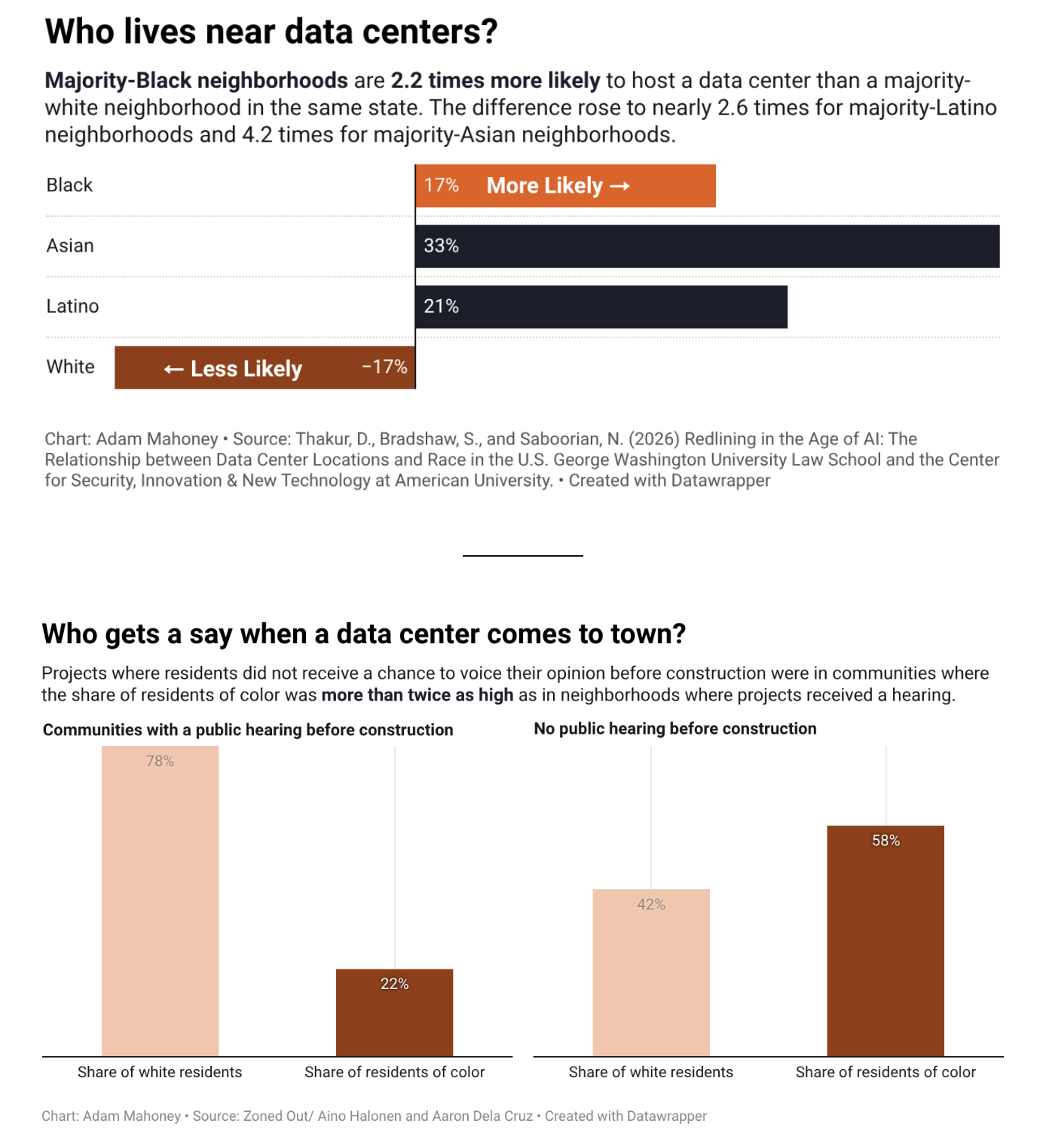
The 200-acre facility, known as Project Eisenhower, began construction earlier this year after being approved without a public hearing. According to Zoned Out, a tool created by researchers at Harvard University, communities without public hearings before construction are roughly 60% people of color, while those with a hearing are nearly 80% white.
Black communities are more than twice as likely to host a data center than white ones and far less likely to receive a chance to voice their concerns before approval. Environmental racism has plagued Black communities for generations, and the data center boom is extending this pattern. Black communities host infrastructure that generates wealth elsewhere while living with the pollution, disinvestment, and health impacts associated with these facilities.
Researchers at George Washington University Law School found that neighborhoods with larger Black, Latino, and Asian populations remain most likely to have negative experiences with data centers, even after accounting for income, population density, home values, and proximity to major power lines.
Rewritten by urgent.news; may contain errors — check the original.
Source: motherjones.com