Following the “mathocalypse,” mathematicians consider the future
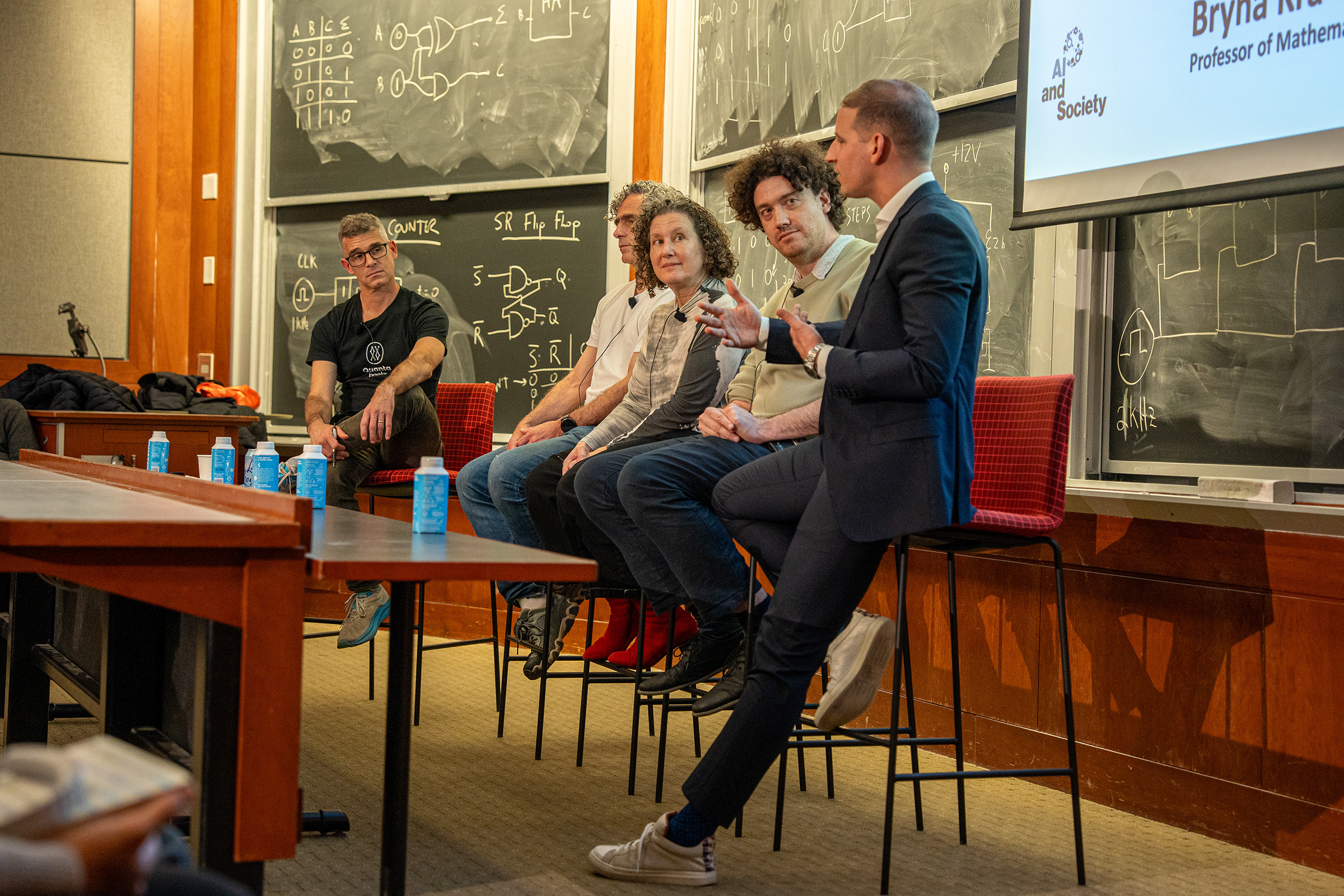
A panel discussion at MIT explored AI’s implications for mathematical discovery and the people who make it their profession.
The year 2025 marked a pivotal moment in the field of mathematics, as artificial intelligence (AI) began to solve complex problems with unprecedented speed and efficiency. OpenAI's recent achievement of solving the Navier-Stokes equation, a Millennium Prize Problem, within 88 hours by deploying thousands of AI agents, sparked a wave of controversy and debate among mathematicians.
The event, dubbed the "mathocalypse," has raised existential questions about the future of human mathematicians and the impact of AI on mathematical research.
Jacopo Borga, the Cecil and Ida Green Career Development Assistant Professor of Mathematics at MIT, highlighted how AI has altered the landscape of mathematical research. He noted that AI's power has changed the very nature of what it means to be a mathematician and how one advances human knowledge. "It's like the first sentence in 'A Tale of Two Cities': 'It was the best of times, it was the worst of times.' It's a really exciting moment ... and also scary," said Kra.
The rapid advancement of AI has also led to questions about the quality and validity of AI-generated proofs. Michael Hopkins, the George Putnam Professor of Pure and Applied Mathematics at Harvard University, expressed concern about the legitimacy of AI proofs, stating that they often contain "strange ideas." He emphasized that while AI can solve problems, it remains unclear how the AI agents arrive at their conclusions, raising doubts about the authenticity of these proofs.
Tristan Buckmaster, a professor of mathematics at New York University's Courant Institute of Mathematical Sciences, acknowledged the need for mathematicians to adapt to the changing landscape. He pointed out that traditional mathematical norms, such as competition and the prestige of being the first to prove an idea, may no longer hold the same weight in the age of AI.
However, Buckmaster also stressed the importance of human understanding in mathematics, arguing that for mathematics to remain meaningful, it must have a human component.
In response to these challenges, mathematicians are already reevaluating their approach to research. Bryna Kra, the Sarah Rebecca Roland Professor of Mathematics at Northwestern University, called for a shift in how mathematicians assess the value of their work. She urged the community to move away from a focus on competition and first-mover advantage, instead emphasizing the importance of communication and clear understanding of proofs.
The panelists also discussed the potential for mathematicians to pioneer new ways of sharing and communicating mathematical discoveries, even in the face of AI's dominance. Kra, for instance, had recently helped draft the Leiden Declaration on Artificial Intelligence and Mathematics, a statement signed by mathematicians worldwide that calls for addressing the risks AI poses to mathematical research.
By focusing on communication and understanding, Kra believes mathematicians can carve out new avenues for innovation and progress in the era of AI.
Written by urgent.news from MIT News AI's reporting — not their text. Machine-written — may contain errors; check the original before relying on it.