Ultrasound imaging without the gel
A new dry material could replace the traditional goopy gel for wearable ultrasound patches.
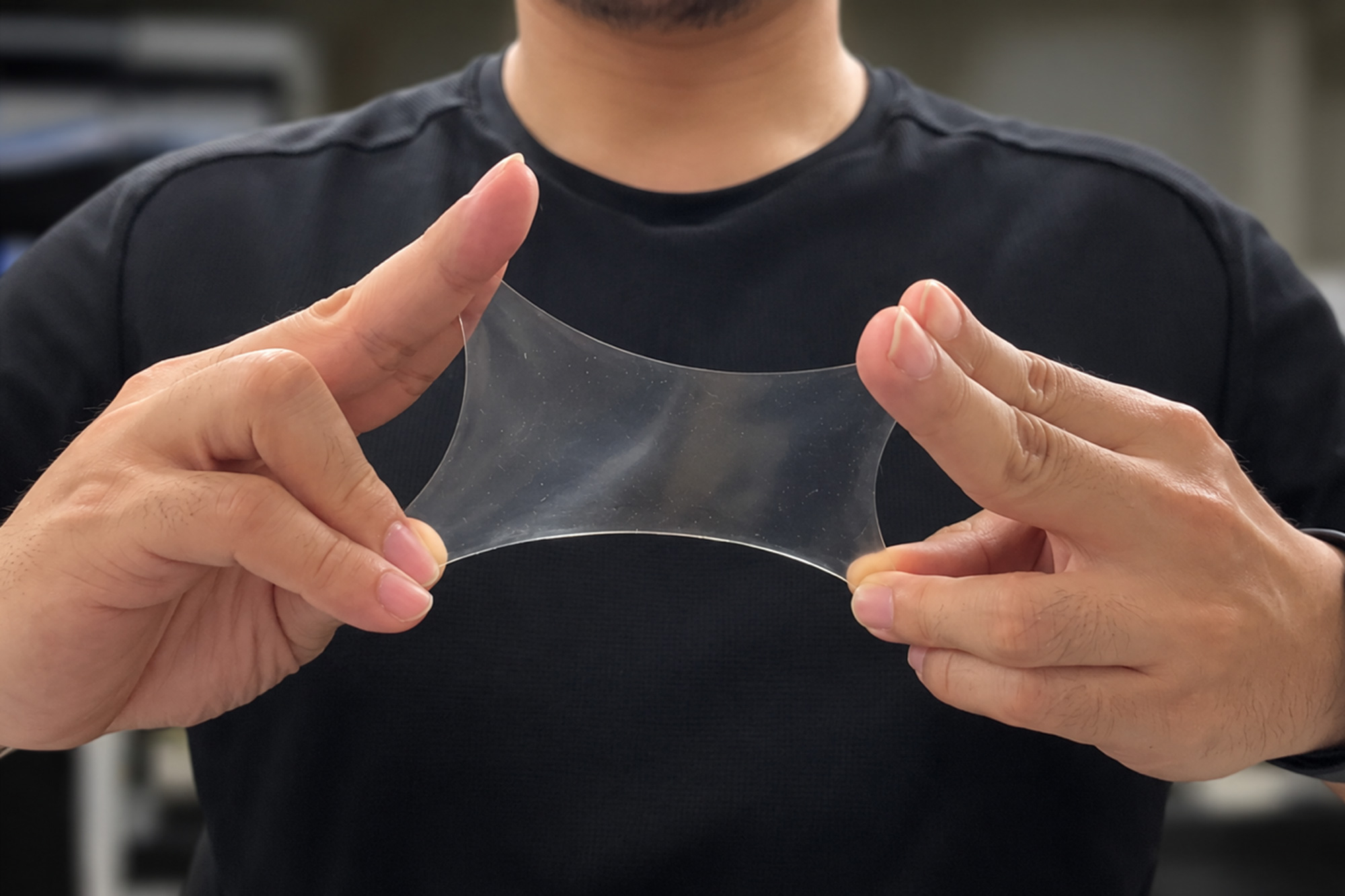
Engineers from MIT and the Singapore-MIT Alliance for Research and Technology have devised a dry and stretchy material that could potentially replace the need for wet and sticky ultrasound gel. In traditional ultrasound imaging, a technician applies a gel to a patient's skin to bridge the gap between the probe and the skin, enabling the transmission of ultrasound waves and the generation of precise images.
However, this gel can dry out within a day or two, losing its ability to transmit sound waves and limiting the long-term usability of wearable ultrasound devices.
Led by Xuanhe Zhao, Uncas and Helen Whitaker Professor of Mechanical Engineering at MIT, the research team developed a liquid-free alternative to gel that maintains its ultrasound transmissivity over extended periods. The material is inherently dry, ensuring consistent performance even when subjected to rigorous conditions, such as during intense physical activity.
To demonstrate the material's viability, the team attached a small wearable patch, roughly the size of a key fob, to a volunteer's neck. This patch contained a small ultrasound probe and the dry, stretchy layer that directly contacted the skin. The patch, connected to a portable tablet, recorded the ultrasound images as the volunteer rode a bike for 30 minutes along a predetermined route.
MIT researchers, including Zhao, postdoc Shu Wang, and co-lead author Runze Li, believe that their innovative material could significantly advance the field of wearable ultrasound imaging. By eliminating the need for gel, the new technology offers the potential for continuous, at-home, or on-the-go imaging, making it a promising solution for various medical applications.
The team's work is part of the SMART WITEC interdisciplinary research group, with co-lead principal investigators Zhao, Xiaodong Chen, and Chwee Teck Lim, all of whom are affiliated with MIT, the University of Wisconsin at Madison, the National University of Singapore, and Nanyang Technological University.
Written by urgent.news from MIT News Research's reporting — not their text. Machine-written — may contain errors; check the original before relying on it.
Also reported by 1 other outlet
- Ultrasound imaging without the goop: A gel-free patch shows promise medicalxpress.com