Microsoft's SideWinder Strategic Commander was a failed attempt to reimagine RTS controls. 23 years later, why are some players still using it?
PC players have been conditioned for decades to accept the keyboard-and-mouse setup for RTS games . One hand has to handle movement and commands through a keyboard, while the other points, drags, and selects with a mouse. Peripheral makers have, usually with the addition of more buttons, made many minor variations to this time-honored arrangement, but there's only ever been one real attempt to…
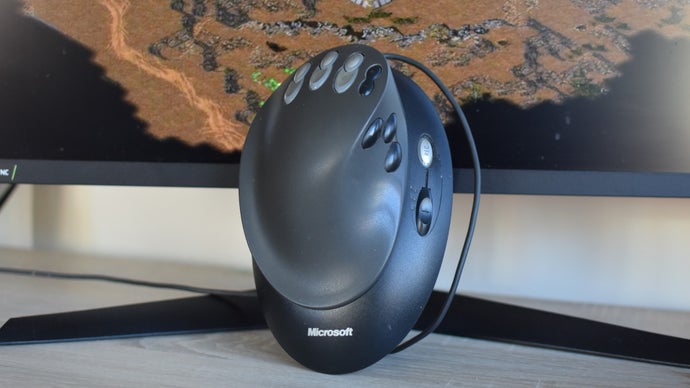
In 2000, Microsoft unveiled the SideWinder Strategic Commander at its Gamestock event, an attempt to revolutionize RTS controls. This device, one of three additions to Microsoft's SideWinder line, was designed to be used left-handed alongside a right-handed mouse. It featured a unique combination of mouse, joystick, and gamepad controls, complete with six programmable buttons, three shift buttons, and a three-position profile switch.
The Strategic Commander aimed to enhance RTS gameplay with faster, more fluid, and comfortable control placement, optimized for multiple hand sizes, simplicity of setup, and ease of programming.
Microsoft demonstrated the device at E3, showcasing its potential for games like Diablo II, Warcraft III, and Baldur's Gate II. At the time, the RTS genre was experiencing its Golden Age, with the controller touted as the most innovative peripheral designed specifically for strategy players. Despite these claims, the Strategic Commander failed to gain widespread adoption, being discontinued in 2003 due to declining sales and the industry's shift toward standard M+K setups.
However, the Strategic Commander's post-shelf life took an unexpected turn. Niche fanbase developed around the device, thanks to software patches that enabled its continued use on newer operating systems. Andreas Weis, a computer science student, developed one of the earliest patches, allowing the device to remain functional even as the original software stopped supporting newer Windows versions.
Weis' work led to the creation of the Strategic Commander's library, which enabled users to program their own applications for the device, expanding its utility beyond RTS games.
Despite its specific design and limited appeal, the Strategic Commander has maintained a passionate following. The device's production quality, combined with its unique features and the community's dedication to preserving it, has ensured its lasting impact on the gaming world, years after Microsoft deemed it a failure.
Written by urgent.news from Rock Paper Shotgun's reporting — not their text. Machine-written — may contain errors; check the original before relying on it.