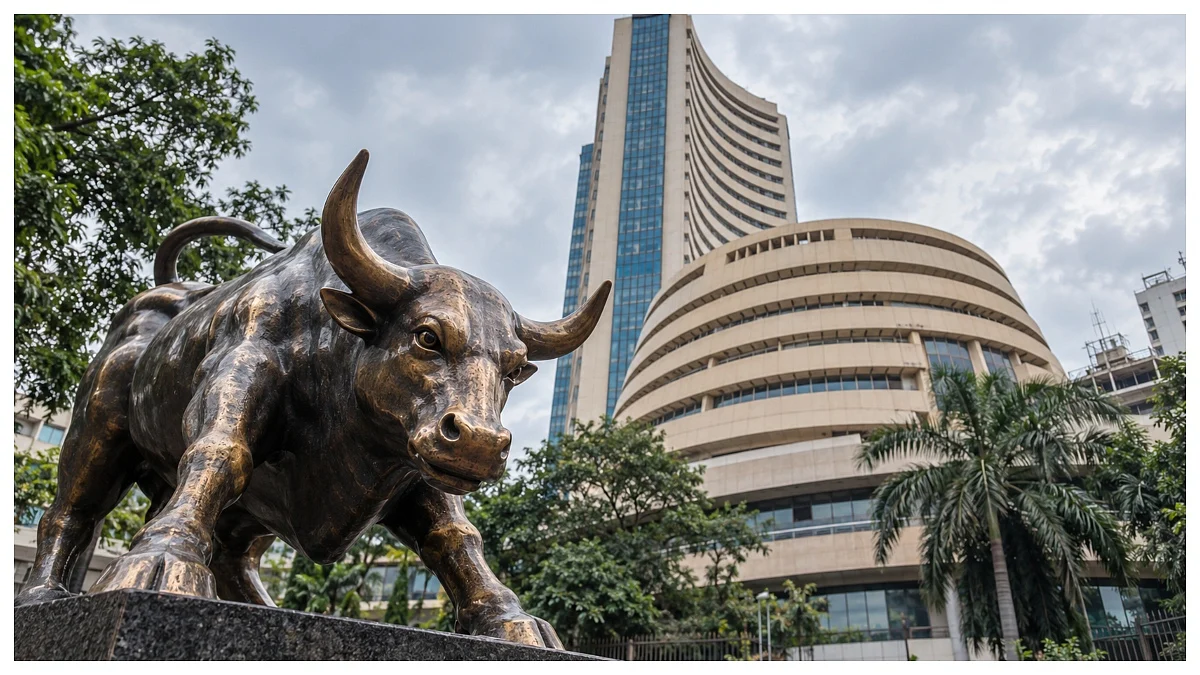
Retail investors caught the falling knife with Rs 15,000 crore investment. 5 stock bets are already bouncing back
Amid market uncertainties, retail investors poured nearly Rs 15,000 crore into eight companies that suffered significant declines. Within a month, five stocks, including BSE and HDFC Bank, showed impressive rebounds. Conversely, others like Hindustan Copper and PFC continued their downward spiral. This mixed performance highlights the challenges faced by investors adopting a buy-the-dip strategy,…
Retail investors poured approximately Rs 15,000 crore into eight stocks that had dropped in value during the third quarter, anticipating a market recovery. Within a month, five of these stocks had begun to recover, with BSE up 17%, Groww up 16%, Reliance Industries up 15%, and HDFC Bank up 12.5%. Tata Motors Passenger Vehicles also saw a slight increase of 0.5%.
However, not all stocks recovered equally, as Hindustan Copper, Suzlon Energy, and Power Finance Corp dropped by 6%, 5%, and 2%, respectively, indicating that buying during market dips remains risky even when some predictions prove correct.
The largest retail investment was in HDFC Bank, with holdings increasing by an estimated Rs 5,610 crore during the quarter, following a 11.18% decline. BSE was the second-largest retail purchase, with a Rs 2,568 crore investment, after falling 20% before rebounding 17%. Reliance Industries attracted Rs 1,409 crore in retail buying after a 8% drop, while Hindustan Copper saw Rs 1,288 crore in purchases despite a 6% decline.
Suzlon Energy, Groww, PFC, and Tata Motors Passenger Vehicles also saw retail investments of Rs 1,050 crore, Rs 1,031 crore, Rs 1,031 crore, and Rs 963 crore, respectively.
Retail investors remained active during the market correction, unlike institutional investors who became more selective. Indian equities saw a recovery in October, with the BSE Sensex up 2.7% and the Nifty 50 up 1.9%. However, the broader market continued to struggle, with the Nifty Midcap 100 down 3.4% and the Nifty Smallcap 100 down 4.1%, suggesting a preference for large-cap stocks.
Corporate earnings improved in the second quarter, with growth becoming more widespread across sectors. Valuation premiums for mid-cap and small-cap stocks also declined, but valuations still remained high compared to historical averages.
Axis Mutual Fund noted that the recovery in equities and the growing favor for quality and selective investments suggest that market volatility should be seen as an opportunity to gradually build exposure rather than attempting to time the market. They preferred businesses with strong cash flows, pricing power, and credible earnings growth, while warning against excessive reliance on any single market-cap segment.
The preferred sectors included banks, consumer discretionary, manufacturing-linked businesses, domestic capital expenditure, transmission and distribution, industrials, defense, and electronic manufacturing services. Vinay Paharia, CIO at PGIM India Mutual Fund, highlighted the ongoing growth story in India, driven by financialization, consumption, digitization, healthcare, and government capex.
He also mentioned that large-cap stocks had borne the brunt of the valuation reset, appearing more attractive at the current time. However, the "buy the dip" strategy proved limited, as only a few of the eight stocks initially targeted had recovered significantly.
Rewritten by urgent.news; may contain errors — check the original.
Source: economictimes.indiatimes.com